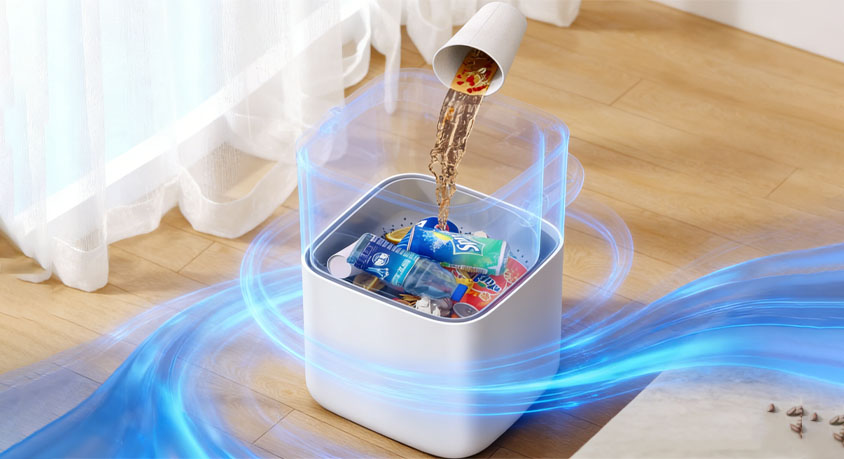
You discard an empty prescription bottle, a crumpled fast-food bag, and the packaging from an expensive electronic gadget. This is mundane waste. To a smart trash can equipped with an RFID reader and a camera, it is a detailed, timestamped inventory of your personal life. In 2026, the push for perfect recycling and waste reduction has birthed connected bins that promise to sort your trash automatically. Their secondary, unadvertised function is to compile a ledger of your consumption. The device you bought to be environmentally responsible is conducting a continuous audit of your household, creating a dataset that reveals more about you than your social media profile ever could.
The technology leverages two primary sensors. First, the RFID reader. Many modern product packages, from grocery items to pharmaceuticals, contain tiny, passive RFID tags for supply-chain logistics. These tags, often unnoticed, remain active after purchase. When you throw the package away, the bin's reader scans it, logging a unique product code. Second, computer vision. A camera combined with AI identifies non-tagged items by their shape, logo, or text: that specific brand of frozen pizza, that model of smartphone box, that wine bottle. By cross-referencing these data points, the system builds a near-complete catalog of everything leaving your home. Think of it not as a bin, but as a reverse shopping cart, meticulously recording every product's end-of-life.
This data is uniquely intimate and inferential. Your shopping receipts show what you buy. Your trash shows what you consume and discard. The difference is profound. It reveals the gap between intention and action (health foods purchased but thrown away uneaten), flags changes in behavior (a sudden increase in prescription or comfort food packaging), and indicates financial stress (a shift from premium to generic brands). This isn't just metadata; it's a biometric of your household's physical and economic health. The privacy policy governing this data is typically focused on "improving recycling services," but the raw information—your consumption fingerprint—is a standalone asset.
The data pipeline extends beyond your home. To provide "valuable insights" like carbon footprint reports or recycling scores, this data is transmitted to the manufacturer's cloud. From there, it can be anonymized, aggregated, and sold into the massive ecosystem of consumer analytics. While your name may be detached, your precise consumption pattern, linked to your geographic and demographic bracket, is highly valuable for competitive intelligence, targeted advertising, and even risk assessment by insurers. A municipality offering discount waste collection for using "smart" bins could potentially access aggregated data to model public health trends or enforcement of waste ordinances, creating a soft surveillance network via sanitation.
Therefore, your deployment of this technology must be governed by strict data containment protocols. Step one is the pre-purchase investigation. Before buying, demand from the manufacturer a complete data flow diagram. Specifically, ask: Is RFID and image data processed locally on the device, or is it transmitted? Can all "smart" features function in a local-only mode with cloud connectivity permanently disabled? If they cannot guarantee local processing, the device is a data harvester, not a tool. Do not acquire it. Step two is physical and digital neutralization. If you own one, physically disable or cover the camera lens with opaque tape. Use an RFID signal-blocking pouch (a Faraday bag for your trash) to store tagged packaging before disposal, or simply deactivate tags by piercing them with a pin. Place the bin on a dedicated IoT network VLAN with no internet access, sacrificing "insights" for privacy. Step three is active data rights assertion. Use data subject access requests (under laws like GDPR or CCPA) to retrieve all data the company holds on your household's waste stream. Then, exercise your right to deletion. Repeat this quarterly to minimize your persistent profile.
The smart trash can is a solution to a waste problem that creates a data problem. Your goal is to accept the mechanical sorting aid while rejecting the behavioral audit. The only waste stream that should leave your home is the physical one. Ensure the digital twin of your trash is deleted at the source. Treat the device's connectivity as a threat to be eliminated, not a feature to be embraced. Your consumption habits are your private concern. A truly intelligent bin should be a dumb terminal that sorts, not a smart sensor that reports. Configure it accordingly, or revert to the profound, private simplicity of an unconnected can.
Disclaimer: Mention of any brand or trademark is for identification only and does not imply partnership or endorsement