The Central Valley of California produces a quarter of the nation’s food. It does so by pulling water from aquifers that are being depleted faster than they can recharge, by relying on a seasonal cycle that becomes less predictable each year, and by distributing produce across thousands of miles of highway. This system has been remarkably productive, but its productivity depends on conditions that are no longer stable. When the drought came in 2022, farmers left fields fallow. When the rains returned, they came as floods. The land itself remains fertile. The conditions surrounding it have become unreliable.
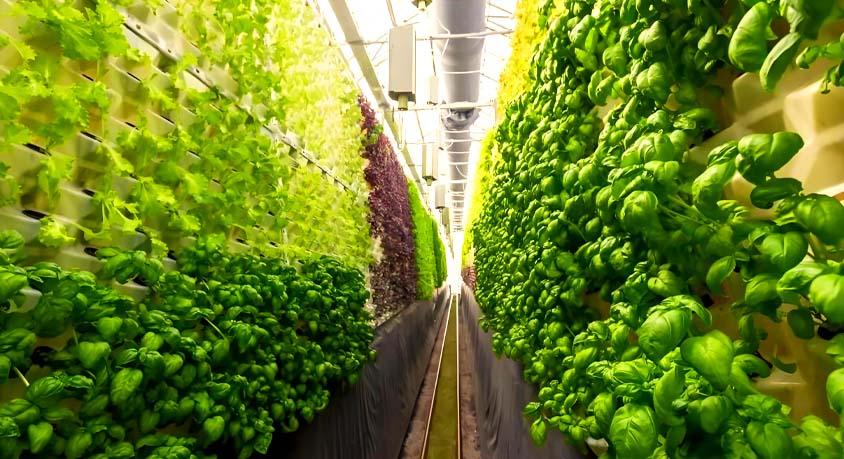
A different approach to agriculture has been developing in parallel, not in rural valleys but in converted warehouses, abandoned factories, and shipping containers stacked on the edges of cities. These are vertical farms—indoors, stacked, illuminated entirely by LEDs, irrigated with recirculating water systems. They produce crops without soil, without weather, without pesticides, and without the vast infrastructure of irrigation canals and tractors. A single vertical farm can grow lettuce, herbs, and leafy greens year-round, independent of what happens outside its walls.
The logic of vertical farming is not that it will replace the Central Valley. It will not. The scale does not match. But the logic addresses a different problem: the vulnerability of a food system that depends on a handful of geographic regions with increasingly unpredictable climates. California grows nearly all of the nation’s leafy greens. When drought or flooding disrupts that production, prices spike, supply chains scramble, and consumers pay more for lettuce that traveled two thousand miles. A vertical farm located in a city, growing lettuce in a controlled environment, bypasses that entire chain.
The engineering that makes this possible is a combination of hydroponics, LED lighting, and environmental control. Hydroponics delivers nutrients directly to plant roots in a water solution that recirculates, using about 90 percent less water than conventional farming. LEDs provide specific wavelengths of light optimized for photosynthesis, running on schedules that accelerate growth cycles. Sensors monitor temperature, humidity, carbon dioxide, and nutrient concentration, adjusting in real time to maintain optimal conditions. The result is a production system that produces consistently, predictably, without weather, without soil, without the chemical inputs that conventional farming requires.
The economic constraints are significant. Vertical farms use energy—substantial amounts of it. LEDs running eighteen hours a day consume electricity, and that electricity has a cost. In regions where power is expensive, the economics do not close. The crops that make sense for vertical farming are those with high value per unit area, fast growth cycles, and susceptibility to weather disruption. Leafy greens, herbs, microgreens. Not wheat. Not corn. Not soy. The vertical farm does not replace the grain belt. It replaces the thousand-mile lettuce.
There is a deeper question here about what food security means. The conventional definition has been about supply at the national or global level—enough calories to feed the population, sufficient reserves to buffer shocks. But the past several years have revealed another dimension: local vulnerability. A drought in California affects grocery stores in Chicago. A freeze in Texas affects tomato availability in New York. The supply chain is efficient, but it is also brittle. Vertical farming offers a different model: distributed production located near consumers, insulated from weather events elsewhere, operating on a cycle that does not depend on seasons.
The technology is not new. Hydroponics has been studied for decades. LED efficiency has improved steadily. What has changed is the convergence of these technologies with a market that now sees the risk in the old model. Investment in vertical farming has been volatile—some companies have failed, some have scaled. But the underlying trend is toward integration. Grocery chains are building their own vertical farms adjacent to distribution centers. Restaurant suppliers are using container farms to grow herbs on site. The model is shifting from speculative to operational.
What makes this development worth attention is not the technology itself but what it reveals about the structure of the food system. The system that feeds the country was built on the assumption of stable climate, abundant water, and cheap energy. Those assumptions are no longer reliable. Vertical farming does not solve the problem of feeding a planet of eight billion people. It solves a more specific problem: how to grow fresh produce in places where the traditional system is becoming less dependable.
The broader question is whether we will treat vertical farming as a supplement or as a replacement for the infrastructure that currently fails. The romantic image of agriculture—fields, tractors, irrigation—obscures the fact that much of what is grown is transported, stored, and wasted. A head of lettuce grown in a warehouse in Chicago, sold the same day, never packed in plastic, never driven across the country, is not a replacement for the romantic image. It is a substitution of logistics for tradition. Whether that substitution spreads depends on cost, on energy prices, on the continued unpredictability of the climate the old system depends on.
The farms in shipping containers are not a revolution. They are a hedge. They exist because the system they hedge against has become less certain. And that, more than any technical breakthrough, is what makes them worth watching. Not because they will feed the world, but because they are being built where the old ways are failing first. The lettuce growing under LEDs does not know about the drought. It does not need to. That is the point.
Disclaimer: Mention of any brand or trademark is for identification only and does not imply partnership or endorsement