
You’ve watched a friend go through chemo. The IV drip. The weeks of exhaustion. The way the treatment meant to save them also stole their appetite, their hair, their energy for months. It’s brutal. But for decades, that was the deal: poison the whole body to kill the cancer, and hope the cancer dies before the patient does. It worked. Sort of. But it was never elegant. It was a carpet bomb when what we really needed was a sniper.
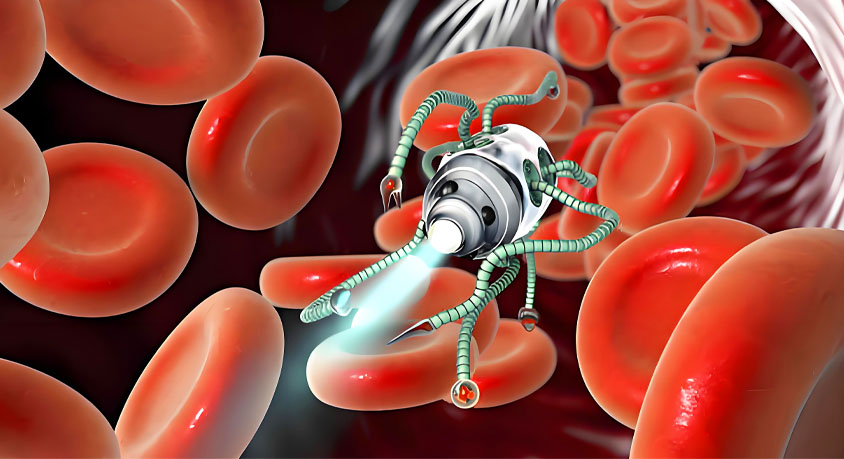
Now imagine this instead. A doctor draws your blood. In a lab, scientists load tiny machines—smaller than a red blood cell—into that sample. Then they inject it back into your vein. Those machines don’t just float around. They hunt. They navigate through your arteries like submarines through ocean currents. They ignore healthy cells. They’re programmed to find one thing: the specific protein signature of your tumor. When they lock on, they release a payload of medicine directly into the cancer. No nausea. No hair loss. No weeks of recovery. Just precision.
This isn’t science fiction. It’s nanorobotics. And after decades of research, it’s entering human trials.
The “robots” are DNA-based or polymer structures, folded like origami, designed to carry drug molecules. Their navigation system isn’t a camera or GPS—it’s biochemical. They’re coated with receptors that bind to specific cancer cell markers. Think of it like a key searching for the right lock. In a healthy person, they’d float through, find nothing, and get filtered out. In a cancer patient, they stick to the tumor like magnets. Once enough accumulate, they release their payload. The drug only activates where the receptors trigger it. Healthy tissue? Never sees it.
The contrast with traditional chemo is stark. Chemotherapy drugs circulate through your entire bloodstream. They attack rapidly dividing cells—which includes cancer, but also your bone marrow, your digestive tract, your hair follicles. That’s why patients lose weight, get infections, feel like they’re falling apart. A nanorobot delivery system doesn’t need to circulate. It just needs to arrive. The dose can be smaller, the side effects dramatically reduced, and the tumor gets hit harder because the drug stays concentrated where it matters.
The data from early trials is genuinely exciting. In a 2023 study published in Nature Nanotechnology, researchers used DNA-based nanorobots loaded with thrombin—a clotting agent—to cut off blood supply to tumors in mice. The tumors shrank. Healthy tissue was untouched. In human trials for certain hard-to-reach cancers like pancreatic and glioblastoma, early-phase results are showing tumor reduction with minimal systemic toxicity. It’s not a cure-all yet, but it’s a shift. For the first time, the mechanism is targeting, not just overwhelming.
Nanorobots are still expensive to manufacture. They require patient-specific engineering—you can’t mass-produce a universal cancer killer because every tumor’s markers are slightly different. There’s also the immune response risk. Your body might decide these tiny machines are invaders and attack them before they reach the tumor. Scientists are solving this by coating them with “don’t eat me” proteins that fool the immune system. It’s cat-and-mouse at a scale you can’t even see.
But here’s where it gets really interesting. These bots aren’t just passive cargo carriers anymore. New generations are being designed with logic gates—simple decision-making ability. If they encounter marker A but not marker B, they release drug one. If they encounter both, they hold and signal. It’s programming biology at the molecular level. We’re not just delivering medicine. We’re teaching machines to make choices inside your bloodstream.
The cultural shift here is massive. For decades, cancer treatment meant suffering. Patients were told to endure because the alternative was worse. Nanorobotics flips that script. It promises treatment that’s quieter, faster, less destructive. It turns cancer therapy from a war of attrition into a targeted operation. You don’t fight the whole body. You just remove the problem.
Chemo isn’t dead yet. But it’s aging fast. And the thing replacing it looks less like a hospital and more like a sci-fi movie you actually want to live through. Your body becomes the battlefield, but for once, the weapons are smart enough to know friend from enemy.
Disclaimer: Mention of any brand or trademark is for identification only and does not imply partnership or endorsement