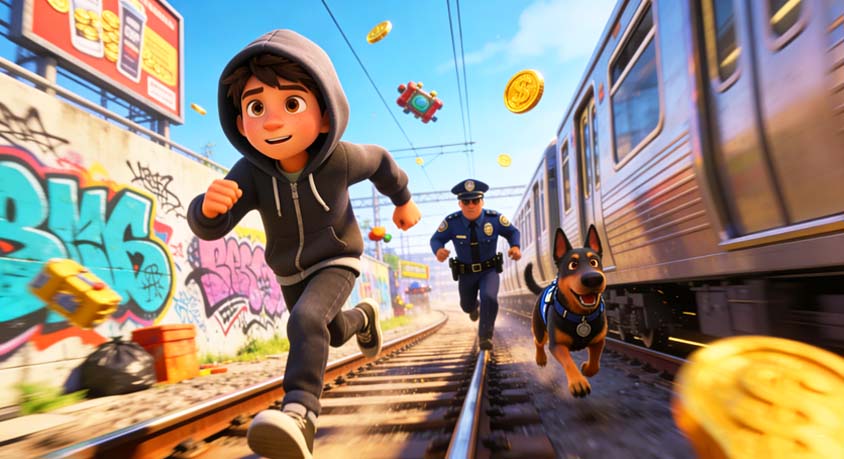
Twelve years. That’s how long this game has been installed on your phone. You’ve deleted it at least seven times, usually to make space for a vacation photo or a new app you forgot about after a week. But it always comes back. A boring commute. A long wait at the doctor’s office. A moment of weakness when you just need to swipe up for three minutes without thinking. Subway Surfers isn’t a game anymore. It’s a reflex. A thumb habit. A digital pacifier that has outlasted three of your relationships and every single “revolutionary” mobile game that promised to change everything. And you still don’t know how to play it properly.
You think you know Subway Surfers. Run down tracks. Dodge trains. Collect coins. Grab the hoverboard when things get spicy. That’s the surface level. That’s what the game wants you to think. But the real game, the one the leaderboard demons play, happens in the gaps between swipes. The magnetic coins aren’t just there to boost your score. They’re breadcrumbs leading you toward the multiplier. The hoverboard isn’t just a shield. It’s a timer that lets you play recklessly for exactly eight seconds. The mystery boxes aren’t random. They drop on a pattern that resets every hundred meters. You’ve been running on autopilot while the game has been quietly teaching you a language you never bothered to learn.
The mechanics run deeper than any endless runner has a right to. The score multiplier, that little number in the corner, is the actual point of the game. Not the distance. Not the coins. The multiplier. Every time you grab a coin or a power-up without breaking your combo, it ticks up. At 10x, you’re earning ten times everything. At 20x, you’re a god. But the multiplier resets when you hit a train, miss a grab, or hesitate for half a second. The game isn’t testing your reflexes. It’s testing your consistency. Can you swipe the exact same pattern for five minutes without a single mistake? Most people can’t. Most people don’t even try. They just run until they crash, then start over. That’s not playing. That’s waiting.
The key to actually getting good, the secret that separates a million-point run from a hundred-million-point run, is learning the rhythm of each map. The game cycles through locations every few weeks: New York, Tokyo, Paris, a dozen others. Each one has the same underlying track structure, but the visual clutter changes. The trains have different colors. The obstacles have different silhouettes. Your brain processes the familiar faster than the unfamiliar. If you play the same location long enough, you stop seeing the decorations. You just see the gaps. The train patterns become predictable. The power-up spawns become clockwork. You’re not reacting anymore. You’re anticipating. That’s when the multiplier climbs into the triple digits.
The power-ups themselves are a tactical layer most players ignore. The jetpack isn’t just a break from swiping. It’s a repositioning tool. Use it to skip a dense cluster of trains that would have broken your combo. The coin magnet isn’t just for greed. It pulls in the power-ups hidden on the side tracks that you would have missed. The sneakers aren’t just speed. They change the timing of your jumps, which can throw off your rhythm or fix it depending on how you use them. The hoverboard isn’t just invincibility. It’s a chance to deliberately hit a train and bounce off it into a better lane. The game rewards aggression, but only if you know when to be reckless.
The audience for this game is everyone with a phone and ten spare minutes. That’s the genius of it. Your mom plays Subway Surfers. Your barista plays Subway Surfers. The kid in the back of class who’s definitely not paying attention plays Subway Surfers. But the people who actually understand it, who chase the leaderboards and grind for the highest multiplier, are a different breed. They’re the ones who treat the game like meditation. A repetitive motion that quiets the brain. A challenge that’s just hard enough to demand focus but not so hard that it creates stress. It’s the mobile equivalent of a fidget spinner that also keeps score.
A few things to know before you start your next run. The game saves your best streak, not your total score. Focus on consistency, not distance. A thousand meters at 50x is worth more than ten thousand meters at 10x. The hoverboard power-up is your emergency brake. Save it for when you’ve already made a mistake, not before. The daily challenges are worth doing. They give keys, which unlock better boards, which let you survive longer, which let you build higher multipliers. It’s a slow loop, but it’s the only path to the real numbers.
Disclaimer: Mention of any brand or trademark is for identification only and does not imply partnership or endorsement