Before the first shovel breaks ground on any significant construction project, there is a period of weeks or months that is invisible to anyone who will eventually use the building. Surveyors walk the site, marking boundaries and elevations. Civil engineers study drainage patterns. Architects make site visits, take photographs, return to the office, and begin sketching. The terrain is measured. The constraints are catalogued. The design begins to take shape. This sequence has been standard practice for centuries. It is also, increasingly, being bypassed.
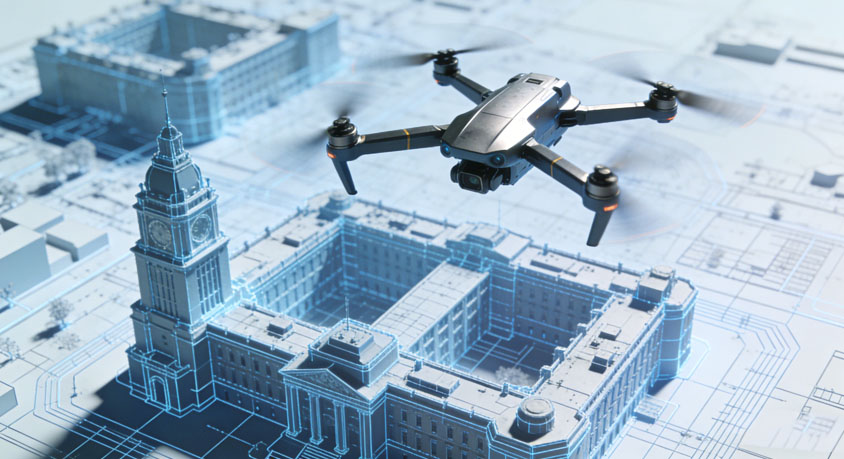
A different workflow is emerging that compresses the front end of construction into days rather than months. It begins with a drone, or more commonly a swarm of drones, that launches from a case, flies a programmed grid over the site, and returns with a complete topographic model in less than an hour. The drones carry LiDAR or high-resolution cameras, capturing millions of data points per second. The output is a point cloud—a three-dimensional representation of the terrain accurate to centimeters. What took survey crews weeks with total stations and GPS rovers can now be done before lunch.
The data from the drone survey feeds directly into a second stage that would have been unimaginable a decade ago. Generative design software, trained on thousands of building typologies, site conditions, and regulatory constraints, takes the terrain model and begins producing architectural options. The algorithm considers solar orientation, prevailing wind patterns, views, access points, and local zoning requirements. It tests thousands of configurations against these constraints, discarding those that fail and refining those that succeed. Within hours, it generates a set of optimized design alternatives that a human architect could not have produced in months, not because the architect is less capable but because the number of variables exceeds what any individual can hold in working memory.
The output of this process is not merely a render or a concept. It is a fully parametric model that includes structural grids, floor plates, facade treatments, and mechanical system routing. The model is construction-ready. It can be exported directly to fabrication files for prefabricated components, or to bid documents for general contractors. The interface between the drone survey and the generative algorithm closes the loop between site conditions and building form in a way that was previously impossible, not because the technology was lacking but because the data transfer between these stages was manual, slow, and prone to error.
What makes this development significant is not the speed increase alone, though that is substantial. It is the inversion of the design process. Traditional architecture begins with a concept—an idea about form, a response to context—and then tests that concept against constraints. The generative model begins with constraints. It maps the site, reads the regulations, models the environmental conditions, and only then explores what forms satisfy those constraints. The output is not the best idea. It is the best fit. The difference is not merely procedural. It reflects a different conception of what design is: a search problem rather than an act of creation.
The implications for the architecture profession are more complex than the familiar refrain that “AI will replace architects.” The tasks that are automated are the ones that architects often find least rewarding: initial site analysis, code compliance checking, schematic iteration. What remains is the work of refinement, of client communication, of navigating the regulatory and political processes that actually determine whether a building gets built. The architect becomes less a form-giver and more a selector and advocate. The algorithm proposes. The human disposes.
There is a deeper question here about the nature of site-specificity. The traditional value of architecture has been its responsiveness to place. A building designed for a hillside in Marin County is different from a building designed for a flat lot in Houston, not just in structure but in orientation, materiality, relationship to light and wind. The drone survey captures the physical conditions of the site with precision that exceeds human observation. The generative algorithm incorporates those conditions into every option it produces. The result is not less site-specific. It is more so. The difference is that the specificity is determined algorithmically rather than intuitively. Whether that produces better buildings is a question that will be answered by built work, not by argument.
The constraints on this workflow are real. Generative design software requires substantial computing power and is currently limited to certain building typologies—housing, offices, warehouses—where the constraints are well understood. It struggles with the unique, the expressive, the programmatically ambiguous. It also raises questions of liability. If a building designed by an algorithm fails, who is responsible? The software vendor? The architect who selected the option? The client who approved it? These questions are not settled, and they will not be settled by technology alone.
What is clear is that the workflow from site to design is being collapsed in ways that change the economics of development. A developer considering a site can now have a full topographic survey and a set of optimized design options in days rather than months. The cost of initial feasibility drops. The ability to compare multiple sites against each other improves. The barrier to entry for smaller developers and community-based projects falls. These are not technical achievements. They are economic shifts enabled by technical ones.
Disclaimer: Mention of any brand or trademark is for identification only and does not imply partnership or endorsement