Let's be real for a second: we've been walking around with our faces in our phones for over a decade now. You're crossing the street, head down, staring at a tiny rectangle, completely blind to the actual world around you. It's giving "zombie apocalypse extras." And honestly? It's embarrassing. There has to be a better way to access information without literally bumping into poles. And guess what? There is. It's going directly into your eyeball.
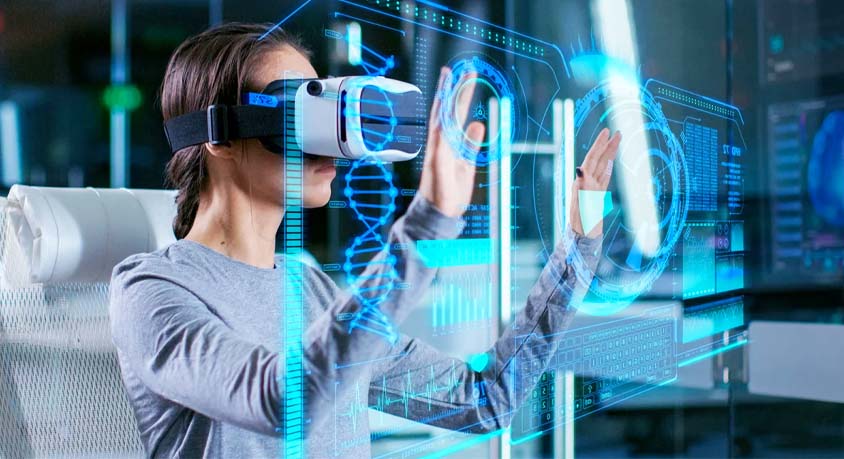
Welcome to the era of smart contact lenses, where the internet doesn't live in your pocket anymore—it lives on your retina. We're talking about microscopic IoT displays embedded in a soft lens that project data directly onto your field of vision. No glasses. No bulky headsets. Just you, seeing the world, with a subtle overlay of literally whatever you need. It's like having a HUD in a video game, but for real life. And it's closer than you think.
Here's how the tech actually works without frying your optic nerve. The lens contains a tiny sapphire chip—sapphire because it's transparent and durable—that communicates wirelessly with your phone or a cloud processor. It uses low-power microLEDs to project images directly onto your retina. You don't see a screen. You see reality, with floating pixels gently placed on top. Think of it like subtitles for the real world. The resolution isn't 4K yet, but it doesn't need to be. You're not watching movies. You're getting context.
Imagine walking into a grocery store. You're standing in the cereal aisle, overwhelmed by 47 options that are all basically the same. With smart lenses, you don't pull out your phone to compare prices. You just look at the boxes. A subtle highlight appears around the one with the best unit price. A tiny tag floats next to the organic option showing it's actually on sale this week. You're not searching for information. The information comes to you, attached to the objects you're already looking at. It's like having a personal shopper who lives in your eye.
Now take it to a social setting. You're at a party. You see someone across the room. You know you've met them before. You know you should know their name. But your brain is drawing a complete blank. Panic mode engaged. With smart lenses, you don't panic. A faint overlay appears next to them: "Alex, met at Matt's birthday, works in graphic design, likes indie rock." You walk up, say "Hey Alex, how's that graphic design project going?" and you look like a memory genius. You're not. You're just wearing the internet on your cornea.
The connectivity layer is pure IoT magic. The lenses are constantly talking to your phone, which is talking to the cloud, which is talking to databases of product info, social media, maps, whatever. Its edge computing meets body hacking. The latency has to be basically zero—if the info arrives after you've already walked past the person, it's useless. That's why the processing happens locally on your phone or a dedicated pendant, with only the display data beamed to the lens. Your eye doesn't care about the math. It just cares about the pixels.
The privacy implications here are genuinely wild. These lenses could record everything you see. Every glance, every person, every price tag. That's terrifying if the data leaves your body. But the ethical design philosophy is clear: all recording should be explicit, with a visible indicator (like a tiny light) so people know when you're capturing. And the data should stay on your device unless you choose to share. You're not building a surveillance state. You're building a better interface for your own brain.
The medical angle is actually the original use case. Diabetics need to monitor glucose constantly. Smart lenses can read glucose levels from your tears and display them in real time. No finger pricks. No separate device. Just look at the corner of your vision and see your numbers. It's health monitoring that doesn't interrupt your life because it's literally part of your vision.
The cultural shift is massive. We've been tethered to screens for decades. The smart lens cuts the tether. You're not looking down anymore. You're looking forward, at actual humans, at actual places, with the digital world gently layered on top instead of replacing reality. It's not an escape. It's augmentation. You're not leaving the real world for the digital one. You're bringing the digital one with you, where it belongs.
Disclaimer: Mention of any brand or trademark is for identification only and does not imply partnership or endorsement