You drop a plastic bottle into a recycling bin. In that moment, you have performed a small, good deed. What happens next, however, is not a story about individual virtue. It is a story about systems—about how material moves through the world, where it gets trapped, and where it escapes. For decades, the escape points were everywhere. A bottle dropped in Jakarta could float through the Ciliwung River, reach the Java Sea, and eventually drift into the Pacific garbage patch, where it would fragment into microplastics over the next four hundred years. That pathway is now being interrupted, not by changing human behavior, but by placing machines at the precise points where waste moves from land to water.
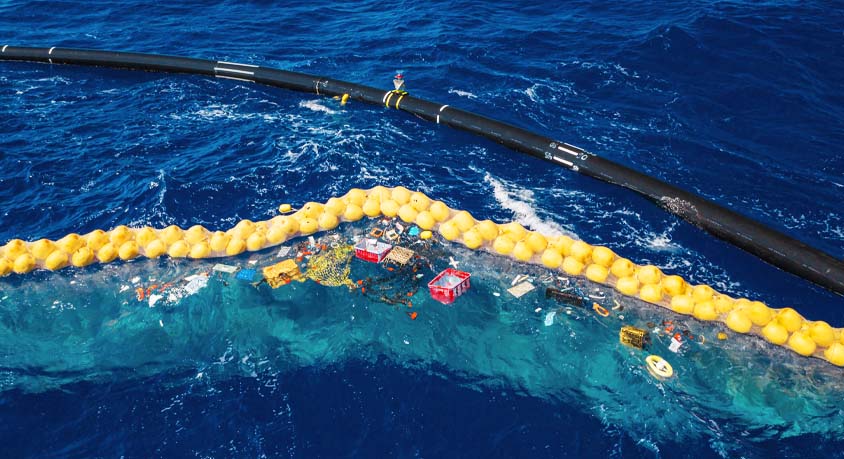
The logic behind this approach is deceptively simple. Roughly 80 percent of ocean plastic comes from rivers, and the majority of that comes from a relatively small number of rivers concentrated in Southeast Asia, Africa, and Latin America. If you can intercept plastic at those river mouths, you can dramatically reduce what reaches the ocean. This is where a new class of autonomous, solar-powered collection vessels enters the picture. The most widely deployed of these is the Interceptor, a floating platform that sits in rivers, guided by a barrier that funnels floating debris toward its opening. Inside, a conveyor belt pulls the waste onto a shuttle system that distributes it into dumpsters. The entire operation runs on solar panels mounted on the roof of the vessel, requires no human operator on board, and can extract up to fifty tons of plastic per day from a single river.
What makes this system more than a mechanical curiosity is the way it integrates with the broader waste management infrastructure. The Interceptor does not sort the plastic it collects. It simply extracts it, compresses it, and sends it to shore, where the next layer of technology takes over. This is where AI-powered sorting facilities enter the chain. These are not the manual sorting lines of the past, where workers stood for hours separating materials by hand. Instead, they use computer vision systems trained on millions of images to identify objects by type, color, and material composition with a speed and accuracy that exceeds human capability. A camera above a conveyor belt sees a PET bottle moving at two meters per second. The AI identifies it, triggers a puff of air, and the bottle is diverted into a separate stream. The same happens for HDPE, polypropylene, aluminum, and the various other materials that flow through the system.
The engineering challenge here is not simply recognition but contamination. A plastic bottle with a metal cap and a paper label is not one material but three. A food container with residual grease may be technically recyclable but practically rejected by conventional systems. AI-driven sorting addresses this by making decisions at a level of granularity that human sorters cannot sustain. The machine does not tire. It does not misidentify a black plastic tray as non-recyclable because the lighting changed. It processes thousands of items per hour, building a dataset of what is actually flowing through the waste stream rather than relying on estimates.
What emerges from this combination of river interception and AI sorting is a closed loop that was previously theoretical. The plastic removed from the Ciliwung River can, in principle, be sorted, cleaned, and reintroduced into manufacturing supply chains. It does not become ocean plastic. It becomes feedstock. This is the structural shift that distinguishes current efforts from earlier cleanup initiatives. The older model was linear: collect waste from beaches, transport it to landfills, repeat. The newer model is circular: intercept at the point of entry, sort at high resolution, return to production.
There are, of course, limits to what these systems can achieve. They do not address the upstream problem of plastic production itself. They are expensive to deploy and maintain, requiring infrastructure that many of the most affected regions lack. They also introduce new questions about ownership and accountability. When a system intercepts waste from a river in Guatemala and processes it in a facility funded by European investors, who owns that material? Who decides what happens to it? These are not trivial concerns, but they are the kind of questions that emerge when a technological solution begins to function at scale.
What makes the current moment worth examining is not that the problem of ocean plastic is solved—it is not—but that the architecture for solving it is becoming visible. The solution is not a single device or a single policy. It is a network: floating collectors at river mouths, AI systems on sorting lines, and logistics networks that move material back into production. Each piece is imperfect on its own. Together, they create a system that did not exist ten years ago.
The plastic bottle you threw out this morning may still end up in a landfill. But it is significantly less likely to end up in the ocean than it would have been a decade ago. That change is not the result of a global awakening or a ban on single-use plastics alone. It is the result of placing machines where the waste flows and giving them the capacity to see what they are handling. The problem of ocean plastic is still immense. For the first time, however, the infrastructure for solving it is beginning to match the scale of the problem. Whether that infrastructure expands quickly enough is the open question. But the direction is finally clear.
Disclaimer: Mention of any brand or trademark is for identification only and does not imply partnership or endorsement