



You feel thirsty. Your brain registers a signal that your body has been sending for the past twenty minutes. By the time you reach for water, your fluid balance has already shifted, your electrolyte concentration has changed, and your cognitive performance has begun its slow descent. This lag between physiological state and conscious awareness is not a design flaw. It is simply how human perception works—indirect, delayed, and easily overridden by attention. The question is not whether we can close this gap, but what happens when we do.
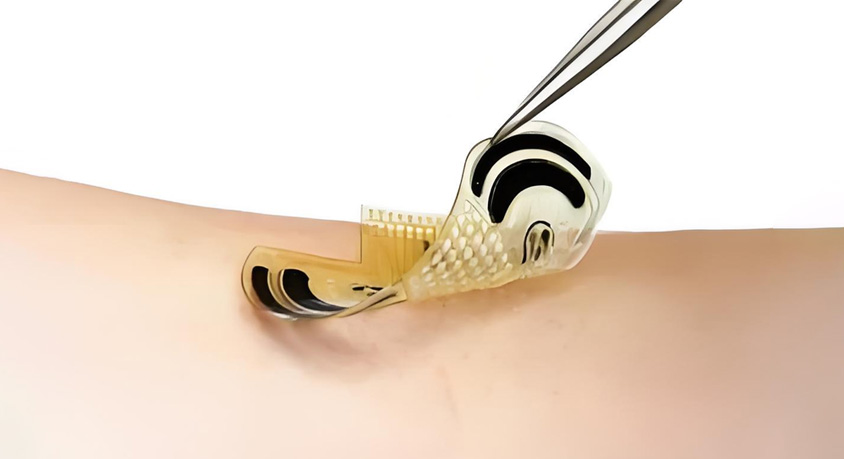
A new class of wearable devices is beginning to eliminate that lag, not by improving your subjective awareness, but by placing a continuous sensor directly on your skin that reads what your body is doing and reports it before you feel it. These are not smartwatches with optical heart rate sensors. They are epidermal electronics—flexible patches the size of a bandage that adhere to the skin, measure biochemical markers in sweat and interstitial fluid, and transmit that data wirelessly to a phone or medical provider. They track glucose, lactate, hydration levels, and electrolyte balance without needles, without blood draws, and without the user having to think about them.
What makes these devices structurally different from earlier wearables is the layer of skin they interact with. A wrist-worn optical sensor estimates heart rate by measuring light absorption through capillaries. It is convenient but indirect. An epidermal patch, by contrast, sits on the skin’s surface and analyzes the sweat that naturally passes through it. The sweat contains electrolytes—sodium, potassium, chloride—that reflect hydration status. It contains lactate, which rises with muscle fatigue. It contains glucose, which correlates with blood sugar with a small time lag. The patch does not guess. It samples.
The engineering challenge here is not simply miniaturization, though that is part of it. It is the problem of continuous, stable contact with a dynamic surface. Skin moves. It stretches. It sheds cells. It sweats. A sensor that works perfectly in a lab can fail within hours on a human arm. The solution has emerged from materials science: stretchable circuits printed on flexible substrates, microfluidic channels that wick sweat across sensors, and biocompatible adhesives that maintain contact without causing irritation. The result is a device that conforms to the body rather than forcing the body to conform to it.
The applications currently in clinical use focus on diabetes management and athletic performance. Continuous glucose monitors, already widely adopted, represent the first wave of this technology. They have transformed diabetes care by providing real-time glucose data without finger pricks. The next wave is broader. Hydration patches, now in development, can alert athletes to fluid loss before performance drops. Lactate sensors can indicate when a runner is pushing into anaerobic territory. In hospital settings, similar patches can monitor post-surgical patients without tethering them to bedside monitors, allowing earlier ambulation and shorter recovery times.
Beyond monitoring, there is a second layer of functionality that points toward something more invasive in the literal sense: haptic feedback through the skin. Some epidermal patches incorporate actuators that vibrate against the skin, creating a silent communication channel. A patch on the neck can relay spoken words as tactile patterns, a technology that has been developed for hearing-impaired users but generalizes to any situation where audio is impractical or undesirable. A patch on the arm can deliver notifications that are private, silent, and impossible to miss. This is not a new idea—tactile communication has been studied for decades—but the packaging into a discreet, skin-adherent device makes it feasible for everyday use.
The structural question these devices raise is not whether they work. They do. The question is what happens to the relationship between a person and their body when the body’s internal states become continuously visible. Currently, you experience thirst as a sensation, hunger as a feeling, fatigue as a vague reluctance to continue. With a patch, you would experience these as numbers, trends, and alerts. You would know you are dehydrated before you feel thirsty. You would know your glucose is dropping before you feel lightheaded. You would have data that your subjective experience cannot provide.
This inversion—data preceding sensation—is not necessarily negative. For someone managing diabetes, it is liberating. For an endurance athlete, it is performance-enhancing. But it also introduces a layer of mediation between self and body that did not exist before. The patch does not simply report. It interprets. It sets thresholds. It decides what counts as normal, what counts as concerning, and when to interrupt you with an alert. These are design choices, not neutral observations. And they are being made by engineers, not by you.
The privacy implications follow from the intimacy of the data. A glucose trace reveals not just blood sugar but eating patterns, stress responses, sleep quality, and exercise habits. A hydration trace reveals fluid intake, sweating, and by extension, activity levels and environmental exposure. This is medical data in the formal sense, but it is generated continuously and stored outside traditional medical records. Who owns it? Who has access? What happens when it is shared with insurers, employers, or advertisers? These questions are not new, but the scale and intimacy of epidermal monitoring make them harder to dismiss.
What makes this moment worth examining is not that epidermal sensors will solve a particular medical problem—though they will—but that they represent a fundamental shift in how we access our own physiology. For most of human history, internal states were known only through sensation. Then came intermittent measurement: a thermometer, a blood pressure cuff, a finger prick. Now comes continuous measurement, integrated into the skin, feeding data to algorithms that see patterns we cannot. The patch does not just tell you what your body is doing. It tells you before you know it yourself.
Whether this constitutes liberation or alienation depends on who controls the data and how it is used. But the direction is clear. The skin, once the boundary between self and world, is becoming an interface. And the signals that used to travel only inward now travel outward as well. The question is not whether we will wear these patches. We will. The question is what we do with what they tell us, and who gets to listen.
Disclaimer: Mention of any brand or trademark is for identification only and does not imply partnership or endorsement