My flip-flop chose to die two kilometers inside a jungle that had no signal, no trail markers, and a humidity level that made breathing feel like drinking soup.
The left strap snapped. The right one was already hanging on by a thread. My friend Ben looked at me, looked at the mud puddle ahead, and said, “You’re about to become a barefoot influencer.”
That was hour three of our “self-guided” adventure into Hang En cave. The tour companies told us it was impossible. They wanted $300 per person for a two-day trek with safety briefings and a Vietnamese army ration pack. We paid $0 for the map that a local homestay owner drew on a napkin.
Let me explain how Phong Nha really works. The town of Son Trach exists for one reason: selling cave tours. Every guesthouse, every restaurant, every motorbike rental shop takes a cut from the big operators like Oxalis. Those tours are professional, sure. They also cost more than my first car.
We arrived by overnight train from Hanoi to Dong Hoi. The soft sleeper cabin was 650,000 dong ($26) per person. A taxi from Dong Hoi to Phong Nha town wanted 500k. We walked five minutes to the local bus station and paid 45k each ($1.80). Same road. Same time. Different prices.
The homestay we booked, Phong Nha Farmstay, is run by a Vietnamese-Australian guy named Ben (confusing, I know). He took one look at our cheap sneakers and laughed. “You’re doing Hang En yourselves? The rangers will stop you.” We went anyway at 5 AM.
The trailhead is behind the abandoned zoo. Yes, there’s an abandoned zoo near one of the world’s largest caves. The cages are empty now, but the macaques that used to live there still hang around, judging tourists who forgot to bring snacks.
We followed the dry riverbed for an hour before the actual jungle started. The path is technically “closed” because of unexploded ordnance warnings from the war – signs every fifty meters with red skulls. A local farmer told us the day before, “Bombs are all gone. Signs stay to scare foreigners.” I chose to believe him.
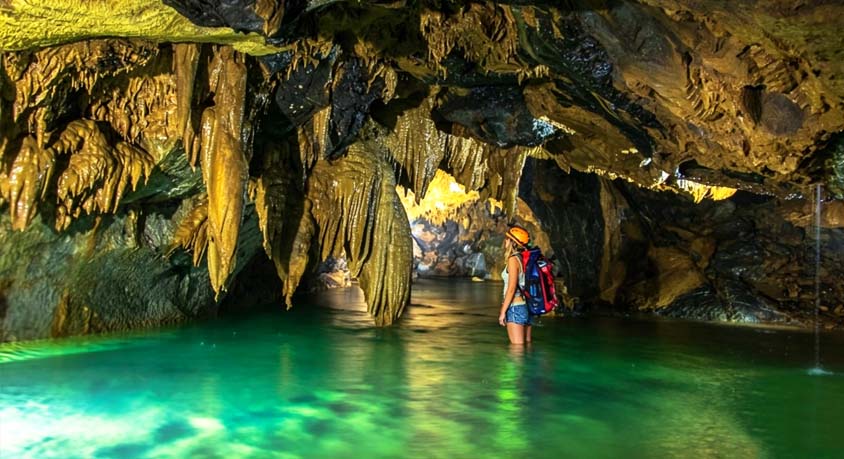
Hang En’s entrance appears without warning. The ground just opens into a hole the size of a football field, with a green river pouring out of it like someone turned on a giant faucet. We stood there for a full minute not talking. Ben whispered, “Worth the flip-flop?”
Inside, the cave swallows any sound you make. We waded through knee-deep water past rocks that looked like melted candles. A beam of sunlight from a ceiling collapse hit a sandbank where two other backpackers were already camped – they’d paid $35 each for a “local guide” who left them there with a tent and a promise to return tomorrow.
We didn’t have a tent. We didn’t plan to sleep. But we sat on that sandbank for an hour, eating stale rice crackers, watching a freshwater eel hunt in the shallows. The cave temperature was perfectly cool. Outside, the jungle was roasting.
Here’s the small cave nobody tells you about. Ten minutes before Hang En’s entrance, there’s a hole in the rock wall to your left, maybe waist-high. Crawl through. It opens into a dry chamber with a ceiling covered in fist-sized bats and the most insane acoustics I’ve ever heard. Ben hummed the Jurassic Park theme. The echo made it sound like an orchestra. No tour guide stops here because there’s no room for a group photo.
Back in town, the food situation is either overpriced Westernized Vietnamese food (120k for pho, laughable) or actual local prices if you know where to look. A place called Vegetarian Restaurant – no English sign, just a picture of a leaf – serves a tofu and mushroom hotpot for 40k that could feed two people. We ate there three nights in a row. The owner’s son plays mobile games at full volume, and the floor is sticky. That’s how you know it’s real.
For the main attraction, Paradise Cave is the famous one. The boardwalk costs 250k entry plus 150k for the electric buggy. We skipped the buggy, walked the 1.5 kilometer uphill path, and passed ten buggies stuck behind a slower buggy. The cave itself is huge and lit up like a discotheque. Not my thing.
But the Dark Cave (Hang Toi) is where the fun actually lives. Most tourists do the “Dark Cave package” for 450k – zip line into the lake, mud bath, kayak. We showed up at 4 PM, thirty minutes before closing. The ticket seller was already packing up. I offered 100k cash just to go into the mud section. She shrugged, took it, and said, “Be out in twenty minutes.”
We were the only people in the entire cave. The mud is thick enough to float in, like a warm chocolate milkshake that smells like farts. Ben got mud in his ear and couldn’t hear properly for two days. Worth it.
Season timing matters more here than almost anywhere else. From September to December, the rains flood the river cave systems. Phong Nha town turns into a boat-access-only situation. We went in late February – dry, cool mornings, hot afternoons, perfect water levels. The dry season (March to August) means lower water and easier walking, but also more tourists and dust.
The cheapest thing we did cost nothing. Behind the Phong Nha cave boat pier, there’s a trail that follows the Son River upstream. After fifteen minutes, the tourist boats disappear and you’re walking past rice paddies where water buffalo stare at you like you owe them money. A kilometer further, a rope swing hangs from a banyan tree over a deep pool. A local kid showed us how to use it. His grandmother watched from her porch, shelling peanuts. No entrance fee. No souvenir stand.
We stayed for four days. Total cost for two people including train from Hanoi, all food, accommodation (shared bunks at Farmstay’s budget dorm), bus fares, the bribe for Dark Cave, and the broken flip-flop replacement (bought from a market stall for 35k): 2,100,000 dong per person. Eighty-two US dollars.
The big cave tour that everyone raves about costs four times that for one night. We saw the same river, the same limestone, and a family of civet cats hunting at dusk on the abandoned zoo road. Ben’s ear cleared up after three days. The mud stain on his shirt never did.
We didn’t see the world’s largest cave – Hang Son Doong. That one really does cost $3,000 and requires booking a year in advance. But sitting on that sandbank inside Hang En, listening to water drip somewhere in the dark, I realized I didn’t need the biggest. I just needed the one that didn’t come with a receipt the size of my rent.
Disclaimer: Mention of any brand or trademark is for identification only and does not imply partnership or endorsement