
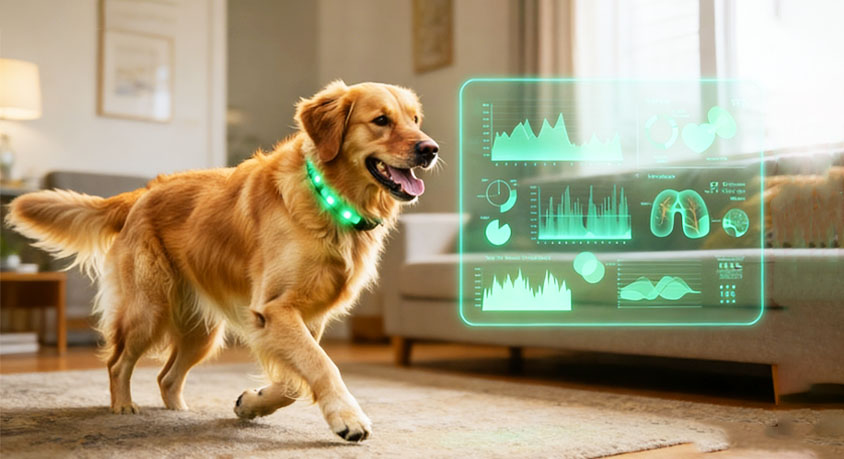
You love your dog. You bought her a smart collar. It tracks her steps, her sleep, her location. It gives you peace of mind. You know when she is resting, when she is anxious, when she needs more exercise. The app sends you notifications. It also sends you ads. Premium dog food appears in your feed. A new brand of dental chews shows up on your social media. A pet insurance company mails you a quote. You wonder: did the collar tell them something? The answer is yes. Indirectly, anonymously, but unmistakably, your dog is now a data source.
The pet tech industry is booming. GPS collars, activity monitors, smart feeders, and treat cameras are standard equipment for the modern pet owner. They serve genuine needs: finding a lost dog, monitoring an elderly pet's health, ensuring they are fed on schedule. But every connected device generates data exhaust. That exhaust has value. And the companies that make the devices are in the business of extracting it.
Consider the activity tracker. It knows how many steps your dog takes per day. It knows her resting heart rate. It knows her sleep patterns. Over time, it builds a profile. If her activity drops, the app suggests a vet visit. It also suggests a brand of joint supplements. The supplement company pays for that placement. You click. You buy. The collar company gets a commission. Your dog's laziness just generated revenue.
The location data is even richer. Your dog's collar knows where you walk, how long you stay, and how often you visit certain places. It knows if you go to the dog park every Saturday. It knows if you stop at a particular pet store. It knows the route of your morning walk. This data, aggregated across thousands of users, reveals patterns. It shows pet supply companies where to place ads. It shows city planners where to build dog parks. It shows insurers which neighborhoods have the most active dogs, and therefore, potentially, the healthiest pets.
The insurance angle is the sharpest. Pet insurance is a growing market. Premiums are based on risk. Risk is based on breed, age, and location. But what if insurers could see actual data? What if they knew that your Labrador walks only 2,000 steps per day, well below the breed average? That dog is at higher risk for obesity, joint problems, and diabetes. The insurer would love to know that. They could adjust your premium, or exclude certain conditions. The collar company could sell them that insight. They would not sell your name. They would sell a segment: "zip code 90210, Labrador retrievers, below-average activity level." That segment is valuable. You are in it.
The privacy policies are vague. Most pet tech companies collect "anonymized" data. They share it with "partners." They use it for "research." They improve their "services." These are the standard weasel words of the IoT industry. They do not lie. They just do not tell you that your dog's sleep score is being bundled and sold to a company that wants to sell you a orthopedic bed. They do not tell you that your walking route is being used to target local pet store coupons. They do not tell you because they do not have to. You agreed to the terms. You clicked "I accept." You never read them.
The irony is that you bought the collar to protect your dog. You wanted to know if she ran away. You wanted to know if she was sick. Now the collar is protecting the company's bottom line, not your dog. It is a sensor for the marketing department. It is a node in a network that treats your pet as a demographic.
The fix is not to abandon the collar. The utility is real. A lost dog found is worth any privacy trade. But you can limit the exhaust. First, check the settings. Turn off data sharing if the option exists. Many apps bury it in a menu labeled "Improve our service." Uncheck that box. Second, use a secondary email for the account. Do not link it to your primary identity. Third, consider a collar that stores data locally, on your phone, rather than in the cloud. Some devices offer this. They cost more upfront, but they do not generate a revenue stream from your dog. Fourth, if you use a smart feeder or camera, put it on a separate Wi-Fi network. Isolate it from your main devices. The dog does not need to talk to your bank.
The pet tech industry will grow. The data will become more granular. Soon, collars will measure glucose levels, hormone fluctuations, and stress markers. That data will be invaluable for health. It will also be invaluable for marketing. The same sensor that detects your dog's anxiety could trigger an ad for calming chews. The same collar that tracks her estrus cycle could trigger offers for spaying services. The line between care and commerce will blur.
Your dog does not know she is wearing a tracking device. She does not know that her morning walk is being analyzed. She just knows she loves you. You are the one who decides what the collar does with her data. Treat it like your own. Assume it is being collected. Assume it is being sold. Act accordingly. The collar is for her safety. It does not need to be for their profit.
Disclaimer: Mention of any brand or trademark is for identification only and does not imply partnership or endorsement