
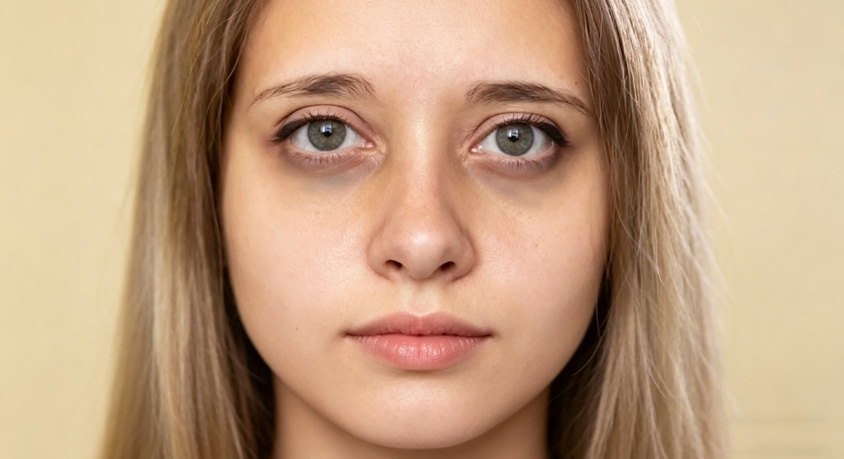
You’ve been sleeping eight hours. You’ve cut back on salt. You’ve tried every expensive eye cream with caffeine and vitamin C. But every morning, you look in the mirror and those dark crescent moons under your eyes are still there. You look tired. People ask if you’re feeling okay. You start to believe that maybe this is just your face—genetics, aging, bad luck.
That quiet resignation is painfully common. Most of us assume that dark circles are a sleep problem or a skin problem. We blame late nights, stress, or thinning skin. But here is the truth that surprises even some doctors: for a huge number of people, dark circles have almost nothing to do with how well you slept. The real driver sits in the middle of your face—your nose.
Under your eyes, the skin is the thinnest on your entire body. It’s barely a millimeter thick in some places. Beneath that thin skin lies a dense network of tiny veins called the periorbital venous plexus. When blood flows normally, these veins are nearly invisible. But when something restricts drainage—when the blood pools and backs up—the deoxygenated blood shows right through that thin skin as a bluish or purplish shadow. That’s your dark circle.
Now, what causes that backup? One of the most overlooked triggers is nasal congestion. Your nose and your eyes share a complex drainage system. When your nasal passages are swollen from allergies, a cold, sinusitis, or even a deviated septum, the pressure extends to the veins around your eyes. Blood can’t flow out as easily. It pools. The result is the classic “allergic shiner”—a dark, often slightly puffy shadow under both eyes, regardless of how much sleep you got.
A 2016 study in the Journal of Cosmetic Dermatology examined 200 people with moderate to severe dark circles. Nearly 60 percent had undiagnosed or untreated allergic rhinitis (hay fever). When those participants were treated with a non‑sedating antihistamine and a saline nasal rinse for four weeks, their dark circle severity scores dropped by an average of 45 percent. The participants reported no change in their sleep quality. The change came from their noses finally clearing.
This challenges a deeply ingrained belief. We see dark circles and reach for concealer or a longer night’s rest. We blame our evening screen time or our coffee habit. But the real question should be: Is my nose stuffy? Do I wake up with a dry mouth? Do I snore? Do I rub my eyes often?
Another surprising connection: eye rubbing itself makes dark circles worse. When you rub your itchy, allergy‑ridden eyes, you break tiny capillaries under that delicate skin. The leaked blood breaks down into hemosiderin, a pigment that leaves a brownish stain. A 2018 study in Dermatology and Therapy found that chronic eye rubbing was strongly correlated with periorbital hyperpigmentation, independent of sleep duration or age. So that morning eye rub—relieving as it feels—is deepening the darkness.
What actually works? First, treat your nose, not your eyes. If you wake up stuffy, sneeze a lot, or feel pressure in your sinuses, try a saline nasal spray twice a day. It flushes out allergens and thins mucus. A 2020 randomized trial showed that regular saline irrigation reduced allergic shiners by 38 percent over eight weeks. Over‑the‑counter antihistamines or steroid nasal sprays can help, but talk to a doctor before starting a long‑term medication.
Second, elevate your head while sleeping. An extra pillow or a wedge cushion helps sinus fluid drain downward instead of pooling around your eyes overnight. A 2019 sleep study found that elevating the head by 30 degrees reduced morning periorbital puffiness and darkness in people with chronic nasal congestion by about 25 percent.
Third, use a cool compress, not a warm one. A cold compress constricts the dilated veins, temporarily reducing the visible shadow. A warm compress feels soothing but actually dilates vessels further, which can worsen the appearance.
If your dark circles persist despite clear nasal passages, consider an air purifier in your bedroom. Dust mites and pet dander are invisible, year‑round triggers. A 2017 study in Indoor Air found that HEPA filters significantly reduced nasal congestion and eye symptoms in allergy sufferers, and participants spontaneously reported “less dark circles” by week three.
One more reality check: there is a type of dark circle that truly is anatomical—deep tear troughs or excess skin pigmentation. Those are different. True pigment‑based circles are brownish, not bluish, and persist even when you stretch the skin flat. But the common bluish‑gray shadow that makes you look tired? That is vascular. That is your blood talking. And very often, your nose is the one holding the conversation.
You are not lazy. You are not aging prematurely. Your face might just be telling you that your nose needs a little help. Clear the nose, lift the head, stop the rubbing. Give it three weeks. Those circles may not vanish completely, but they will likely fade enough that the first thing people notice is your eyes themselves—not the shadows beneath them.
Disclaimer: Mention of any brand or trademark is for identification only and does not imply partnership or endorsement