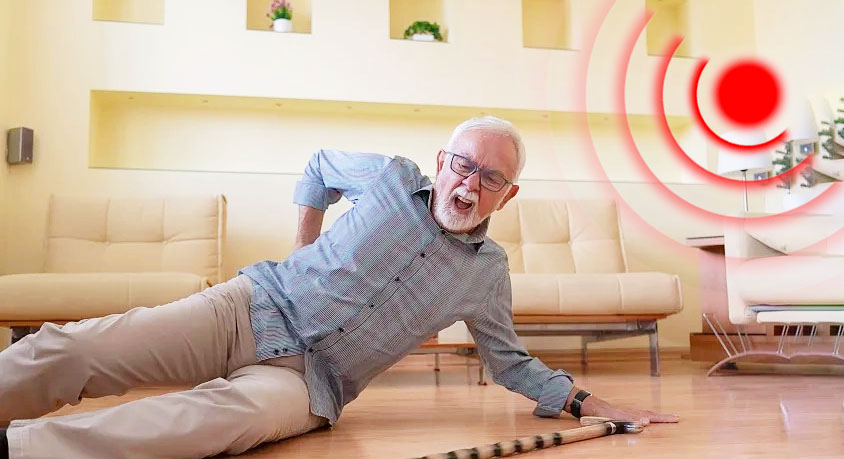
The call you dread comes at 3 AM. Or it doesn’t come at all. A parent living alone falls in the bathroom, hits their head, and cannot reach the phone. The interval between the fall and the discovery can be hours, sometimes days. This scenario is not a statistical abstraction. It is a predictable consequence of a society where people live longer, live alone more often, and age in place by choice or necessity. The conventional solutions have always come with a cost. A camera provides visibility but at the expense of privacy. A wearable pendant requires the user to remember to wear it, charge it, and press it when they cannot move. The failure modes of these devices are exactly the conditions they are meant to address.
A different approach has emerged from a technology originally developed for automotive radar and repurposed for human monitoring. Millimeter-wave radar, operating in the 60 to 80 gigahertz range, emits low-power radio waves and analyzes the reflections. Unlike cameras, it does not record images. Unlike wearables, it does not require the user to do anything. It sits on a wall, in a ceiling, or on a nightstand, and it detects movement, position, and subtle physiological signals through barriers like clothing, bedding, and even drywall. It cannot see what you look like, but it can see whether you are standing, sitting, lying on the floor, or not moving at all.
The physics behind this is worth understanding because it explains both the capability and the limits. Radar measures time of flight and Doppler shift. A signal emitted from the device bounces off objects in the room and returns. The time delay indicates distance. The frequency shift indicates velocity. When a person breathes, their chest moves a few millimeters with each cycle. That motion creates a measurable Doppler shift. The radar can detect breathing rate from across a room without any sensor attached to the body. When a person walks, the radar tracks their path. When they fall, the signal changes from a vertical upright pattern to a horizontal stationary pattern in milliseconds.
What makes this suitable for aging-in-place scenarios is not just the fall detection itself but the continuous baseline it establishes. The device learns what normal movement looks like in a particular space. It knows when someone typically wakes, when they move to the kitchen, how long they spend in the bathroom. A deviation from that pattern—absence of movement for an extended period, a sudden change in position that does not resolve—triggers an alert. The system does not need to distinguish between a fall and a faint and a heart attack. It simply needs to detect that something changed and the person did not get up.
The privacy implications are the inverse of those raised by camera-based monitoring. A camera delivers visual information, which is maximally informative but also maximally intrusive. It captures what you are wearing, who visits you, how you move through your home. Even with strict data controls, the presence of a camera in a living space changes behavior. Radar, by contrast, produces a point cloud—a sparse set of coordinates that represents motion and position but no visual detail. It can tell you that someone is lying on the bathroom floor. It cannot tell you whether they are wearing pajamas or what color the tile is. This distinction matters to people who reject cameras on principle but accept the logic of monitored independence.
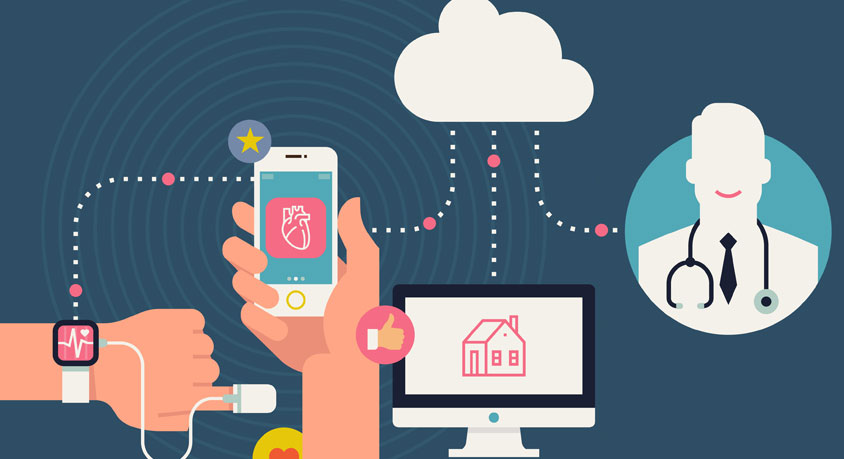
The data generated by these systems raises its own set of questions. A continuous record of movement patterns reveals when a person sleeps, how often they wake at night, whether they use the bathroom frequently, how much time they spend sedentary. This is health data, and it is sensitive. The question of who owns it, who has access, and under what circumstances it can be shared with medical providers or family members is not settled. Some manufacturers store data locally on the device. Others push it to the cloud. The difference is not trivial, and it is often buried in terms of service.
What makes this technology notable is not that it solves the problem of falls—no technology solves that completely—but that it addresses the failure modes of earlier approaches. Cameras failed on privacy grounds. Wearables failed on compliance grounds. Radar fails on neither. It does not require action from the user, and it does not record what the user would consider private. It is passive, continuous, and invisible. For a population that is increasingly reluctant to wear medical devices but increasingly in need of monitoring, this matters.
There is a broader question here about what we mean by independence in later life. Independence is often framed as the absence of help. But for most people, independence means the ability to live according to their own routines without constant surveillance. A camera intrudes on that. A wearable marks the wearer as someone who needs watching. A radar device, mounted on a wall, does neither. It does its work without announcing itself. The person being monitored does not have to perform the role of the monitored.
The devices currently available are not perfect. They can be confused by pets, by moving curtains, by ceiling fans. They require placement that covers the high-risk areas—typically bedrooms and bathrooms—without creating blind spots. They generate false positives, particularly in the early weeks of learning a household’s patterns. But the trajectory is clear. The cost is dropping, the algorithms are improving, and the demographic pressure is increasing. The number of Americans over 65 living alone is projected to rise significantly over the next decade. The infrastructure to support them is not keeping pace. Radar-based monitoring is not a replacement for human care. But it is a tool that addresses a specific gap: the interval between a fall and a response.
The parent who lives alone may never wear a pendant. They may reject a camera outright. But they may accept a small white disc on the ceiling that they forget is there. And that device, quietly and continuously, watches for the signal it was designed to detect. It does not watch them. It watches for the moment when the pattern breaks. That is a different kind of seeing, and for many families, it is enough.
Disclaimer: Mention of any brand or trademark is for identification only and does not imply partnership or endorsement