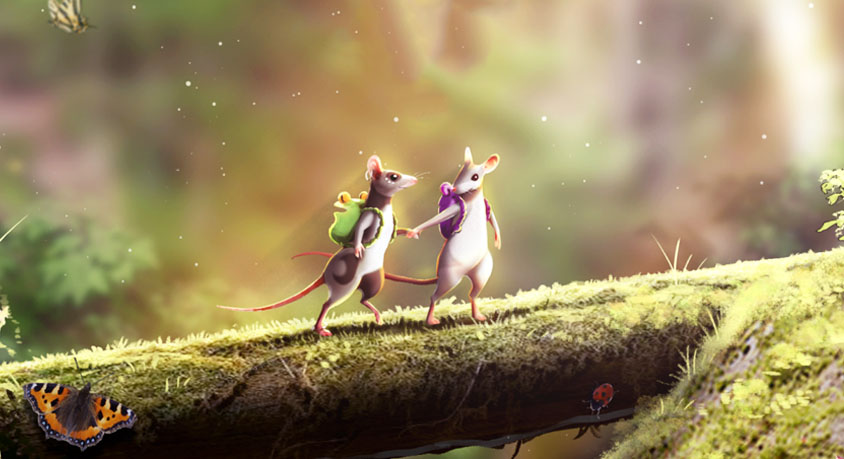
Let me tell you about the smallest, furriest therapist I've ever encountered. She's about three inches tall, has ears she's not entirely in control of, and communicates exclusively in squeaks and expressive tail twitches. Her name is Hela, she's a mouse, and she's currently navigating a vast, beautifully rendered Nordic forest on a mission that doesn't involve saving the world, defeating any gods, or collecting 500 meaningless trinkets. She's just… looking for her family. And somehow, in a year where the news cycle feels like a constant scream and my anxiety is running its own parallel campaign, following this tiny rodent through mossy clearings and ancient pine forests has become the most therapeutic experience I've had with a controller in my hands. Hela isn't just a game. It's a prescription, written in the language of soft footsteps and gentle discovery.
The premise is elegantly simple. You play as Hela, a small mouse separated from her family during a storm. The world is a stylized version of the Nordic wilderness, all towering mushrooms you can climb, massive fallen leaves that serve as bridges, and the constant, gentle presence of a forest that feels alive but never threatening. Your goal is to explore, to follow scents and sounds, to solve environmental puzzles that are more about observation than dexterity. You'll squeeze through tiny passages, scale the roots of ancient trees, and ride floating seeds across small ponds. The scale is everything here. A puddle becomes a lake. A cluster of wildflowers becomes a forest. The world is familiar, but rendered from a perspective that makes everything feel new and slightly magical.
The gameplay mechanics are built around the idea of gentle interaction. Hela can dig small holes to find roots and bulbs. She can climb certain surfaces, but only if they're textured just right. She can carry objects—berries, twigs, shiny stones—and use them to solve simple puzzles or, more often, just to admire them. There's no combat. There's no health bar. The only real threat is getting lost, and even that is softened by the game's generous navigation system, which lets you leave scent trails to find your way back. The game trusts you to explore at your own pace, to get distracted, to spend ten minutes just watching a butterfly. It's a radical act of trust in an industry that usually wants to push you forward.
This is the game's secret weapon: it never demands anything from you. In a world where every app, every notification, every responsibility is screaming for your attention, Hela simply waits. She'll sit by a stream as long as you want her to. She'll watch the sunset. She'll curl up in a hollow log and nap. The game doesn't have a "fast travel" system because why would you want to skip any of this? The journey is the point. The destination, finding her family, matters, but it's not urgent. It's a gentle pull, not a desperate race.
For the player who needs this kind of experience, the audience is specific but vast. It's for anyone whose nervous system is stuck in fight-or-flight mode. It's for the overworked, the overstimulated, the people who love video games but are exhausted by the constant pressure to perform, to react, to win. Hela asks nothing except your presence. It's meditation disguised as a platformer. It's a weighted blanket in digital form. The only thing you need to know going in is that nothing will try to hurt you, nothing will judge you, and nothing will rush you. The game will wait. Hela will wait. The forest will wait.
There are, of course, things to note. The game is short, intentionally so. It's designed to be completed in a few quiet evenings, not a weekend marathon. The puzzles are gentle; if you're looking for brain-teasers, this isn't it. And the emotional payoff, while real, is subtle. You won't cry. You'll just feel… settled. Calm. Like you've taken a deep breath you didn't realize you were holding. That's the magic.
So here's the truth. Hela isn't going to win awards for innovation or graphical fidelity. It's not going to spawn a franchise or dominate the discourse. What it will do, for the people who need it, is offer a small, furry sanctuary. It will remind you that not every story needs a villain. Not every journey needs a battle. Sometimes, the bravest thing you can do is be small in a big world, keep moving, and trust that home is waiting at the end.
Disclaimer: Mention of any brand or trademark is for identification only and does not imply partnership or endorsement