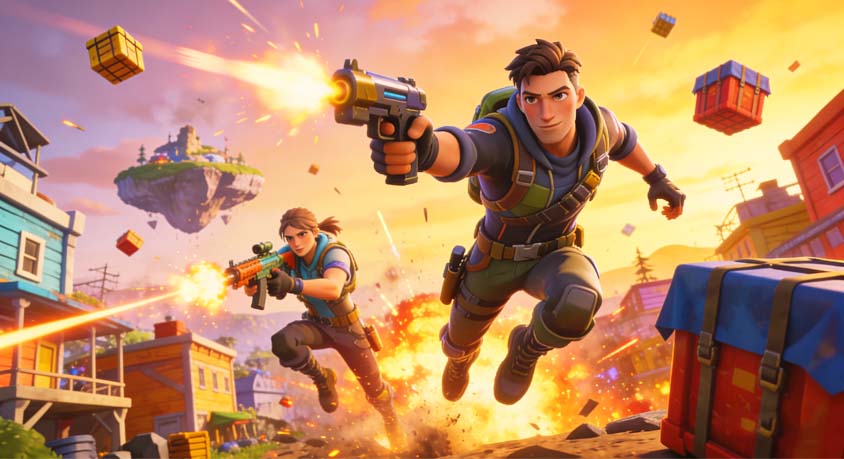
Let’s play a quick word association game. I say “Fortnite.” If you’re a parent, a news anchor from 2018, or someone who still thinks “flossing” is a dental activity, you probably yell, “Battle Royale!” But if you’ve actually logged into the thing anytime in the last two years, a different, more chaotic list comes to mind: Lego survival crafting. Rhythm games with The Weeknd. Racing simulators. Family Guy episodes. A full-blown concert where you can be a dinosaur. At some point, the game that popularized the last-player-standing craze quietly, efficiently, and brilliantly euthanized its own original premise. It didn’t just add new modes; it built a digital theme park around the crumbling skeleton of the Battle Royale island and then made that skeleton just another ride in the back of the park. The real question isn't whether this is genius or a disaster—it’s whether we’re even playing a game anymore, or just living in a mall.
Think about the sheer cognitive whiplash of the modern Fortnite lobby. You can drop into a match with the solemn intent of being the last one standing, practicing your edits and your high-ground retakes. Or, you can decide to spend your evening peacefully building a Lego castle with a friend, then jump over to a user-created obstacle course where the goal is to dance on giant pianos, before capping the night off by watching a movie inside the client itself. The Battle Royale is still there, technically. But it feels less like the main event and more like the “Classic Rock” section in a streaming service that’s aggressively recommending K-pop, audiobooks, and a documentary about mushrooms. It’s been contextually demoted from “the point” to “an option.”
This transformation is either the most cynical or the most visionary move in modern entertainment, depending on how much of your soul you’ve already sold to the digital marketplace. On one hand, it’s a breathtaking display of corporate agility. Epic saw the writing on the wall: no single game mode is forever. Instead of letting Fortnite slowly fade as a Battle Royale fad, they turned it into a platform, a launching pad for literally any experience they can dream up or license. They’ve weaponized FOMO into a permanent state of being. Why leave to play another game when, in five seconds, you can be playing five other games right here, with all your skins and friends list intact? It’s the walled garden to end all walled gardens, landscaped with brand deals and user-generated content.
But here’s where the warmth mixes with the weirdness. For all the corporate machinery at work, something genuinely new and oddly communal has been born. For a generation of players, Fortnite isn’t a game they play; it’s the place they go. It’s the digital main street. The shared social space that previous generations found in malls or parks, they now find here. The “disaster” isn’t in the execution—the execution is masterful. The potential disaster is in the homogenization. When one company controls the plaza, the movie theater, the concert hall, and the art gallery, what happens to the quirky, independent venues down the street? Fortnite’s success as a platform raises a funny, poignant question: in trying to be everything for everyone, does it risk making everywhere feel the same?
So, did they kill Battle Royale? Absolutely. They buried it in the backyard and then built a dazzling, neon-lit carnival on top of the grave. You can still visit the spot if you want, and many do, but the screams of the rollercoaster drown out the gunfire. Is it genius? From a business and cultural staying-power perspective, unquestionably. It’s the ultimate hedge against irrelevance. But it also means that the simple, anxious thrill of being one of the last few people on an island—the purity of that original idea—has been forever lost, absorbed into a boundless, buzzing, and slightly overwhelming digital metropolis. Fortnite didn’t just evolve; it staged a hostile takeover of its own identity. And honestly, we were all too busy building Lego houses or racing Rocket League cars to even notice the coup was complete.
Disclaimer: Mention of any brand or trademark is for identification only and does not imply partnership or endorsement