


The construction site used to have a certain rhythm. The clang of metal, the shout of a foreman, the whistle of someone signaling a crane operator. Walk onto a high-tech site in Tokyo or Oslo today, and the soundscape is different. There's a whirring overhead and a mechanical click-clack on the gravel below. The foreman is still there, but he's inside the portable office, staring at a screen. Outside, the dog is making its rounds.
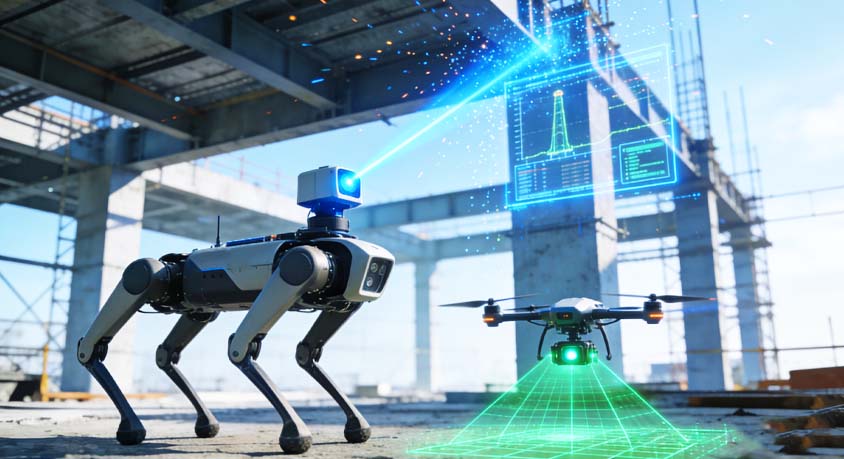
Not a real dog, obviously. This is Boston Dynamics' Spot, the quadruped robot that looks like something between a golden retriever and a piece of heavy machinery. It trots across mud and rebar with the same nonchalance as a labrador fetching a stick, but its head is a sensor array packed with LiDAR and 360-degree cameras. Above it, a swarm of drones moves in coordinated patterns, dipping in and out of the steel framework like birds that never get tired.
A friend of mine runs project management for a commercial developer in Austin, and he sent me a video last month that made me question everything I thought I knew about blue-collar work. The video showed a half-finished high-rise at sunset, completely empty of human workers. But it wasn't abandoned. The site was alive with robots. A drone was mapping the exterior progress against the BIM model, flagging a misaligned window frame that was off by less than an inch. Down on the ground floor, Spot was navigating through dark corridors, its thermal camera picking up an electrical panel that was running hotter than specs allowed—a fire risk no human would have spotted until it was too late.
This is the convergence of IoT and construction that actually moves the needle on safety and efficiency. We're not talking about a gimmick. The numbers from a recent trial in Sweden showed that robotic monitoring reduced on-site safety incidents by 23% in the first six months, not because the robots intervened, but because they detected hazards in real-time. A drone spots a worker without a hard hat in a restricted zone. The system logs it, alerts the supervisor, and the supervisor's voice comes over the PA before the guy even realizes he's been made.
The robots are essentially mobile IoT gateways. They carry sensors that collect data—visual, thermal, spatial—and they transmit that data via 5G or private LTE networks back to a digital twin of the building. That digital twin updates in real-time, creating a live 3D model that engineers can walk through virtually from an office across town. When a drone detects that a steel beam has been installed two centimeters off plan, the model glows red. The project manager doesn't find out next week during an inspection. He finds out in seconds.
What makes this work is the coordination between ground and air assets. The drones handle the macro view, scanning large areas quickly and creating top-down maps. The robot dogs handle the micro details, navigating tight spaces and uneven terrain that would ground any wheeled vehicle. Together, they form a sensor network that covers every square foot of a site, 24 hours a day, in weather that would send human workers home.
Construction kills more people than most industries, and the causes are often predictable: falls from height, struck-by objects, electrocution. Robots don't get tired. They don't miss the loose scaffolding because they were distracted. They scan every bolt, every cable, every time. When Spot walks under a partially completed structure, its upward-facing cameras are analyzing the stability of every connection. If something shifts overnight, the system knows before a human walks under it.
There's a natural anxiety here about jobs, and it's not unfounded. But the reality on the ground is less about replacement and more about evolution. The workers I've talked to who share sites with these machines don't see them as competition. They see them as the guys who do the dangerous pre-checks so they don't have to. The foreman who used to walk the site for three hours every morning now reviews the robot's patrol data over coffee and spends his day actually managing people instead of chasing down problems.
Walk onto a site like this and the first thing you notice is how calm it feels. No shouting. No close calls. Just the whir of machines doing the dirty work and the focused energy of humans doing the skilled work. The dog trots past you without a glance, uploading another terabyte of data to the cloud, and you realize this isn't science fiction. It's just Tuesday on the job site.
Disclaimer: Mention of any brand or trademark is for identification only and does not imply partnership or endorsement