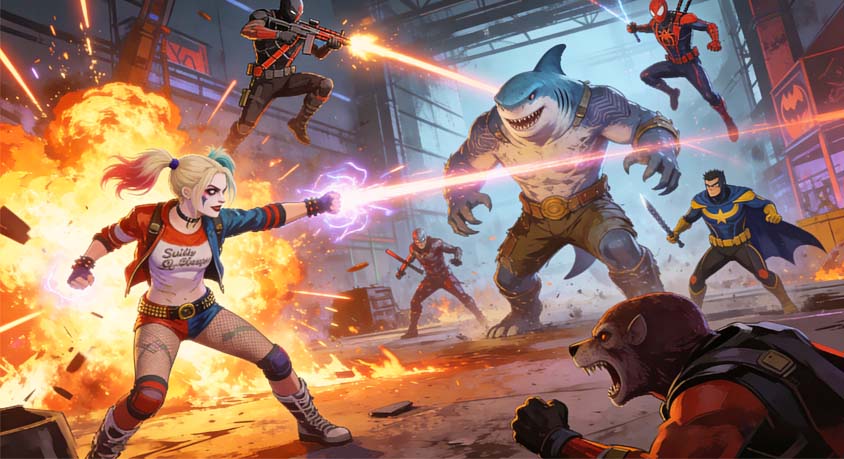
Let's talk about one of the most spectacular, slow-motion train wrecks in modern gaming history. Picture this: you're Rocksteady Studios. You created the greatest superhero video game trilogy of all time with Batman: Arkham. You have a devoted fanbase that would follow you into actual hell. You get handed the keys to the DC universe again, this time with Suicide Squad: Kill the Justice League, a premise so deliciously twisted it could write itself. Harley Quinn, Deadshot, King Shark, and Captain Boomerang, the worst of the worst, forced to take down brainwashed versions of the heroes we've spent decades worshiping. It's a goldmine. It's a slam dunk.
It's... a live service shooter with a battle pass, color-coded loot, and repetitive mission design that feels like it was generated by a committee of spreadsheets. The result? A game that went from "most anticipated" to "who's even playing anymore?" faster than you can say "season pass." This isn't just a failure; it's a case study in how corporate greed, dressed up as "player engagement," can strangle a masterpiece in its crib.
Let's rewind to the first trailer. The tone was perfect. The banter was sharp. The action looked chaotic and fun. The promise was clear: Rocksteady, masters of single-player storytelling, were going to apply their magic to a co-op shooter. Then the gameplay reveal happened. And slowly, the cracks began to show. Instead of the tight, Arkham-style combat we'd dreamed of, we got floaty gunplay and ability cooldowns. Instead of a focused narrative, we got a "live service" roadmap promising seasons and characters and, most ominously, a store. The game wasn't designed to be a complete experience you bought once and loved forever. It was designed to be a platform, a content delivery system, a gentle, persistent tap on your wallet that would continue long after you'd finished the story. The soul of Rocksteady was being replaced by the machine of "player retention metrics."
The actual launch was a masterclass in disappointment. The combat, while functional, lacked the visceral weight of the Arkham games. Hovering and shooting didn't feel like controlling the Suicide Squad; it felt like controlling any other third-person shooter, just with prettier skins. The missions were an exercise in repetition: go here, defend this point, kill these waves, collect these orbs, repeat. The much-hyped "Justice League" boss fights, the emotional core of the premise, were reduced to repetitive bullet sponge encounters that drained the villains of any menace. And looming over everything was the battle pass, the seasonal content, the endless treadmill of rewards designed not to satisfy, but to addict. It was a game built not to be enjoyed, but to be played, indefinitely, like a digital hamster wheel with a DC paint job.
This is the tragedy of the "live service" obsession. Somewhere in the boardroom, a spreadsheet warrior decided that a single-player game, no matter how brilliant, was a finite asset. You sell it once, and that's it. But a live service game? That's a recurring revenue stream. That's a license to print money, one battle pass at a time. What got lost in that calculation was the simple truth that players don't want a service. They want a story. They want characters they care about. They want a world that feels real. They want to finish something and feel satisfied. By prioritizing the endless over the excellent, Rocksteady didn't just make a mediocre game; they betrayed their own legacy. They turned Batman's legacy into a loot box.
The final, bitter irony is the player count. The servers that were supposed to hum with endless activity are now, by all accounts, quiet. The seasonal content that was supposed to keep us hooked arrives to crickets. The game that was supposed to be a platform has become a ghost town, a cautionary tale told in developer post-mortems and angry YouTube essays. It's a monument to the idea that you can't force a community to love your game by locking them into a treadmill. Love has to be earned. And Suicide Squad: Kill the Justice League forgot that the most important thing to kill wasn't the Justice League. It was the greed.
Disclaimer: Mention of any brand or trademark is for identification only and does not imply partnership or endorsement