



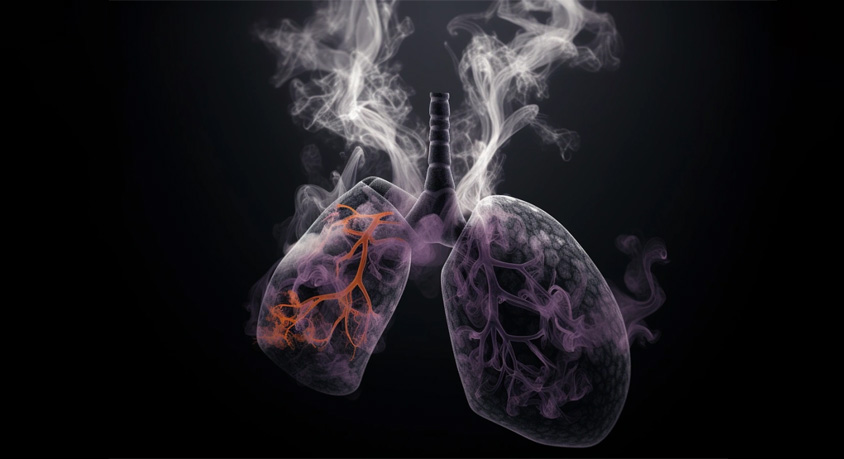
Why do some people smoke a pack of cigarettes every day, live to the age of 90, and still never develop lung cancer?
November 17 is International Lung Cancer Awareness Day. Smoking is recognized as the most important risk factor for lung cancer. During combustion, tobacco produces multiple carcinogenic chemicals, such as polycyclic aromatic hydrocarbons, aromatic compounds and their amines, and nitrosamines. Tobacco itself also contains inorganic carcinogens such as arsenic, nickel, and chromium.
In addition to increasing the risk of lung cancer, smoking also raises the risk of several other cancers, including bladder cancer, esophageal cancer, oral cancer, and breast cancer.
However, many people still cannot understand why quite a number of smokers never develop lung cancer. Some even smoke a pack a day and live to 90 without getting lung cancer, while some people who have never smoked still develop the disease. What exactly is going on?
It is a fact that smoking does not necessarily lead to lung cancer, and nonsmokers may still develop lung cancer. This is undeniable.
Precisely because of this, some people claim that quitting smoking doesn’t matter since smokers don’t necessarily get lung cancer, and nonsmokers might get it anyway.
On the surface, this sounds somewhat reasonable. But in fact, whether from a medical-scientific perspective or basic logic, this argument does not hold up. For smokers who do not develop lung cancer or even live long lives, genetics is a major contributing factor.
Some people are simply born with advantageous genes. There will always be a small number of people who are “different,” carrying specific genes that give them innate resilience. It is similar to how a small number of individuals are “naturally gifted” in certain fields—under the same circumstances, it is impossible to compare with them. But such people are not representative of the general population and cannot be used to draw broad conclusions.
According to a U.S. study, smokers who live long lives may do so because they possess a form of innate resilience. Biologically, these individuals are a distinct group with a particular genetic mutation that enhances cellular maintenance and repair, causing their physiological response to smoking to differ from that of most others.
In other words, smoking does not mean they suffer “no harm,” but because their natural repair capacity is so strong, the actual damage they incur may be minimal. If they did not smoke, they might live even longer. Clearly, most people do not carry such genetic mutations and do not possess this level of innate resilience. Most of us do not have the “privilege” to act recklessly; otherwise, it would simply be self-destructive behavior.
As for carcinogenesis itself, the development of most cancers is not caused by a single factor but by a combination of multiple factors.
Smoking is a major carcinogenic factor for lung cancer, but it is not the only one. In other words, aside from smoking, there are other risk factors. These include family history (genetic predisposition), long-term exposure to air pollution, women’s prolonged exposure to kitchen fumes, and certain occupations involving long-term contact with or exposure to harmful substances or hazardous environments—such as asbestos, coal tar, and arsenic compounds. People working in these occupations have a relatively higher risk of developing lung cancer.
Smokers, aside from the adverse factor of smoking, may do very well in other aspects of their lives. However, it must be emphasized that smoking is an independent and strong risk factor. Even if other aspects are well managed, smoking still significantly increases lung cancer risk. The development of lung cancer results from multiple factors acting together, just as academic performance is determined by various elements. We cannot focus solely on one factor and draw simplistic conclusions.
Additionally, the “survivor bias” must be considered to avoid overgeneralization. A smoker who lives to 90 naturally attracts public attention. When the information you receive comes only from this small group of survivors, the results you see have already undergone invisible screening. It is overgeneralization to treat individual cases as representative of the whole, and any conclusions based on this are inherently inaccurate.
Many things in life are a matter of probability. Smokers have a higher probability of developing lung cancer, but it is not guaranteed. Similarly, people who study hard do not always achieve excellent grades, and those who appear less diligent may sometimes perform well.
However, from a probabilistic standpoint, under the same conditions, those who put in more effort are more likely to achieve better results. The idea that “the harder you work, the luckier you get” applies here. Our choices should be based on higher probabilities, not absolutes. The probability of developing cancer is higher for smokers than for nonsmokers, and the higher the smoking index, the greater the cancer risk.
To understand the complex relationship between smoking and lung cancer, we must move beyond simple cause-and-effect thinking and recognize that health outcomes are the result of multiple interacting factors.
Although some smokers may live long lives, this does not mean smoking is harmless. Each person’s genetics, lifestyle, and environment are different, and these factors together determine individual health outcomes.
We cannot ignore the widespread risks of smoking simply because of a few exceptional cases. To maximize the likelihood of good health, the best choice is not to smoke. For nonsmokers, staying away from tobacco and secondhand smoke is essential. For smokers, quitting smoking as early as possible is the most responsible decision for both themselves and their families.
Disclaimer: Mention of any brand or trademark is for identification only and does not imply partnership or endorsement