Smart home lighting systems play a crucial role in modern homes, especially for large houses with extensive space, it is undoubtedly a significant optimization of living space. So, how exactly does it work?
The lighting control system of a smart home is essentially an automated lighting control system based on the function of a specific area, different time periods, the brightness of the outdoor light or the specific purpose of the area, which forms the infrastructure of the entire smart home.
Intelligent lighting systems have preset functions that can be set in advance for lighting brightness and other needs. These preset settings, also known as scenes, can be invoked either through a dimmer system or automatically by a centralized building control system. When used in a home environment, they usually take the form of an integrated central controller and may be equipped with an operator interface with a touch screen.
From an overall perspective, intelligent lighting systems, as a core component of the smart home, are particularly suitable for large-area housing and can greatly enhance the convenience and comfort of people's lives. Lighting control systems can be categorized as stand-alone, room-specific or large-scale networked systems. In a networked system, dimming devices are usually installed in electrical cabinets and operated by a network of external devices such as sensors and control panels. The significant advantage of a networked system is the ability to control zones in different rooms from numerous points. In a home scenario, a control panel can be installed on a wall near the main entrance and used as the primary control node for multiple rooms.
The smart home lighting system has many significant features. First, it has a high degree of intelligence and automation, and can automatically adjust the lighting brightness, color and switch state according to the preset scenes and conditions, without frequent human intervention. Secondly, the system is highly flexible and customizable, users can freely set different lighting scenes, such as reading mode, movie watching mode, party mode, etc., according to their own habits and needs. Furthermore, energy saving is another major feature. Through intelligent sensing and dimming functions, the system is able to automatically reduce the lighting brightness or turn off the lights in unoccupied areas, thus effectively saving energy. In addition, the smart home lighting system is also able to interconnect with other smart home devices to form a synergistic whole, enhancing the overall intelligence of home life.
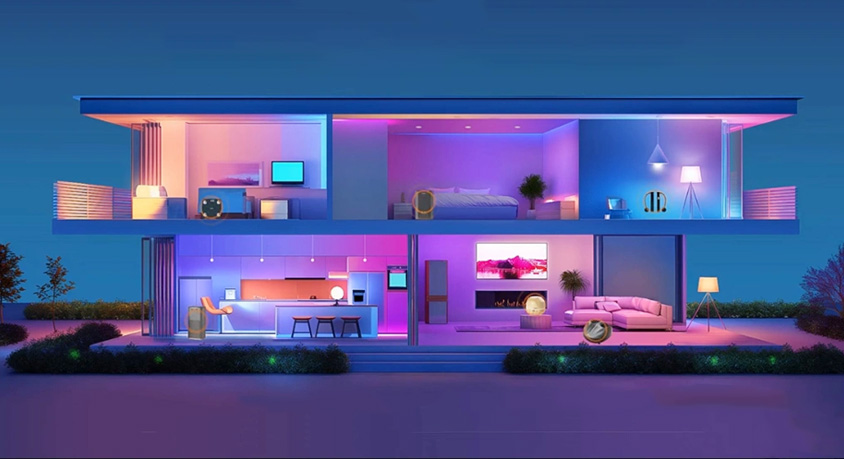
In large homes, there are multiple places that require lighting, such as living rooms, dining rooms, bedrooms, studies, kitchens and so on. In the process of smart home design, the intelligent lighting system will be based on the different requirements of each room, elaborate lighting design and precise control, so as to achieve satisfactory and ideal lighting effect.
Disclaimer: Mention of any brand or trademark is for identification only and does not imply partnership or endorsement