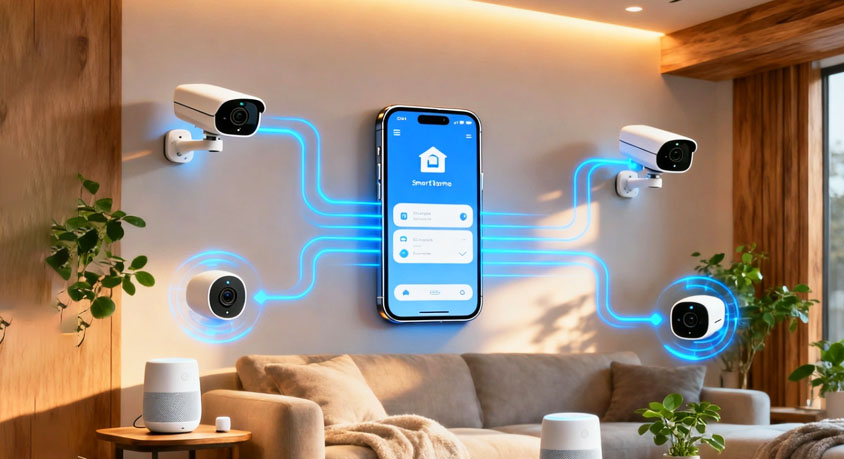
You install a security camera above your front door. It records motion, sends alerts to your phone, and gives you peace of mind. What you may not consider is where that video goes. In most consumer cameras, the footage leaves your home immediately. It travels to a server owned by the camera manufacturer, processed in a data center you’ve never seen, stored on hardware you don’t control. The company’s privacy policy assures you the data is protected. But you’ve read enough breach notifications to know that “protected” is a temporary condition, not a permanent state. The footage of your home, your family, your daily routines, exists somewhere else. You have a copy. So do they.
A different architecture exists, though it is not the default in most consumer products. Cameras designed for local processing, sometimes called edge AI cameras, do not send continuous video to the cloud. Instead, they do their work on the device itself. A processor inside the camera runs a computer vision model that distinguishes a person from a passing car, a delivery driver from a stranger lingering too long. When it detects something worth noting, it sends an alert—a text description, a short clip stored locally—without ever transmitting the raw feed. The video never leaves your property. The company that sold you the camera never has a copy. The risk of a breach exposing your footage is not zero, but it is radically reduced because there is no footage in their possession to breach.
The technical distinction here matters more than the marketing language suggests. A cloud-based camera is a sensor with a network connection. It captures video and ships it elsewhere for analysis. The intelligence—the ability to recognize a person, a package, an animal—resides in the cloud. The camera itself is a dumb terminal. A local-processing camera is a computer that happens to look like a camera. It runs the model locally, makes decisions on-device, and only transmits the minimum information required to serve its function. The intelligence resides in your home. The camera is autonomous.
The implications for privacy are structural, not just procedural. With a cloud camera, your privacy depends on the manufacturer’s security practices, their employee access controls, their data retention policies, and their vulnerability to external attack. You are trusting a company to protect your footage because you have no alternative. With a local camera, you are trusting a device that sits under your control. The manufacturer could still have vulnerabilities—firmware could be compromised, credentials could be mishandled—but the data surface is dramatically smaller. There is no database of your footage waiting to be stolen because the footage never left your home.
There is a trade-off, and it is worth naming. Local processing requires more powerful hardware on the camera itself. The chip that runs the computer vision model adds cost. The camera may be more expensive upfront than a comparable cloud-based model. The cloud model subsidizes the hardware with subscription fees; the local model sells you the hardware and leaves you to manage storage. For many users, the subscription model is simpler: you pay a monthly fee, you never think about storage, you assume the company handles security. The local model asks you to think about where your data lives, to install your own microSD card or set up local network storage, to take responsibility for something you previously outsourced. That responsibility is precisely the point.
The question is not whether cloud cameras are insecure. Many are quite secure. The question is whether the security model itself is the one you want. Cloud security is a shared responsibility between you and a company. You rely on their patching, their encryption, their employee training, their defense against state-level actors. Local security is your responsibility. You control whether the camera is on the network, whether its firmware is updated, who has physical access to the device. For some, the shared model is acceptable. For others, the idea that their front door footage resides on servers in another state, subject to subpoena or breach, is a risk they are not willing to take.
The deeper shift here is about the location of trust. For a decade, the smart home industry pushed everything to the cloud. The cloud was where intelligence lived, where data was processed, where value was created. That model aligned with the business interests of companies that wanted recurring subscription revenue and data to train their models. But it also created a privacy architecture that put the user at the far end of a long chain of custody. Local processing reverses that chain. The device becomes a trusted edge node, accountable primarily to its owner rather than to the company that manufactured it.
This is not a technical debate about which architecture is superior. It is a decision about what kind of relationship you want with your devices. A cloud camera asks you to trust the company. A local camera asks you to trust the hardware and yourself. One is easier. The other is more private. The camera that watches your front door does not need to send video to anyone to do its job. It can watch, decide, and alert without ever exposing the footage. That it does not is a design choice, not a technical necessity. And like most design choices, it reflects priorities. The question is whose priorities those are.
Disclaimer: Mention of any brand or trademark is for identification only and does not imply partnership or endorsement