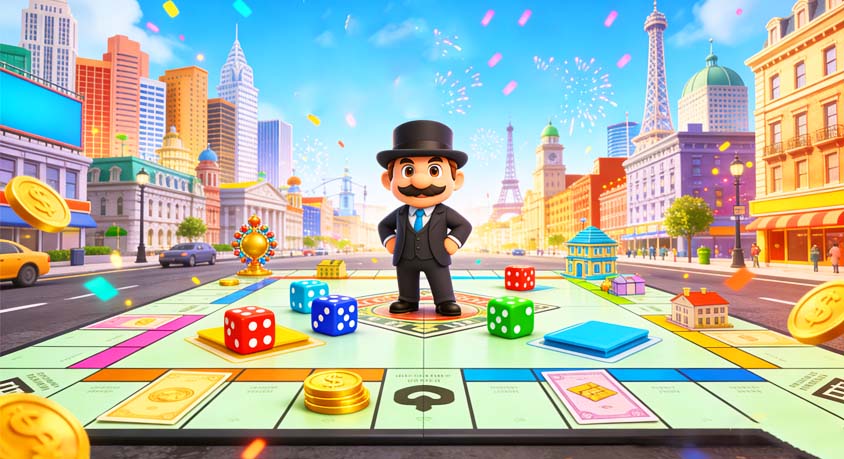
You remember Monopoly from family game nights. The slow spiral of buying properties, building hotels, and watching your cousin flip the board when you land on Boardwalk with a hotel. That game took three hours and ended with someone crying. Monopoly Go! takes three minutes and ends with someone laughing maniacally. It’s the same property trading, rent collecting, bankrupting your friends energy, but compressed into a dopamine slot machine that lives in your pocket. And it has quietly become the most addictive, relationship-testing mobile game since someone decided to put Candy Crush on every phone in America. The twist? You’re not supposed to play fair. The game punishes kindness. It rewards sabotage. And that’s exactly why millions of people can’t put it down.
The core loop is deceptively simple. You roll dice. You move around a board. You collect money and upgrade landmarks. Standard Monopoly stuff. But the devil is in the details they added. Every action feeds into a network of social features designed to make you annoy your friends. When you land on a railroad, you don’t just go to jail. You get to perform a “shutdown” or a “bank heist” on another player’s board. Shutdown means you smash one of their landmarks with a wrecking ball. Bank heist means you steal their cash. The game doesn’t ask permission. It doesn’t offer a friendly trade screen. It just gives you the option to be a menace, and then it shows you exactly how much money you stole and how angry your friend probably is right now.
The social layer is where Monopoly Go! becomes something else entirely. You’re not playing against anonymous bots. You’re playing against people on your friends list, your leaderboard, your co-worker who keeps sending you notifications that you’ve been attacked. The game tracks revenge. If someone shuts down your landmark, a little marker appears next to their name, inviting you to hit them back. It turns the game into a silent war fought through push notifications. You wake up, check your phone, and see that your sister stole 2 million from you at 3 AM. Now it’s personal. Now you’re saving your dice rolls for when her shields are down. The game doesn’t need a chat function. The mechanics themselves are the conversation.
The progression system is engineered to exploit a very specific human weakness: the fear of missing out. Dice rolls regenerate slowly, but you can earn more by completing albums, events, and tournaments. The albums are collections of stickers, each one depicting something from the game. You get duplicates constantly. The game knows you have duplicates. It also knows that your friend has the one sticker you’re missing. So you start trading. You join Facebook groups, Discord servers, Reddit threads dedicated to sticker swapping. You’re not just playing a mobile game anymore. You’re participating in a barter economy where the currency is digital cardboard and the stakes are your sanity. And when you finally complete that album, the game showers you with dice, cash, and the temporary illusion that you can stop playing. You can’t. The next album is already waiting.
The audience for this game is anyone who has ever enjoyed watching someone else suffer a minor inconvenience. It’s for the competitive, the petty, the people who send a “hehe” text after shutting down a friend’s board. It’s also for casual players who just want something to do while waiting for coffee. The game accommodates both. You can play aggressively, timing your rolls for when your targets are offline. Or you can just tap the button and watch numbers go up. The mechanics don’t judge. They just keep rolling.
A few things to know before you download. The game is designed to make you want to spend money. Dice rolls run out. Events tempt you with premium rewards. The store is always there, offering a deal that expires in two hours. You don’t need to buy anything. The game gives you enough free rolls to progress, just slower. Patience beats wallets here, but only if you have the discipline to ignore the timers. Also, be prepared for notifications. The game will remind you that your landmarks are repaired, that a friend attacked you, that an event is ending soon. You can turn them off. But then you might miss your chance for revenge. Your call.
Monopoly Go! took a board game about capitalism and turned it into a phone addiction about friendship destruction. You roll dice, you steal cash, you smash hotels, and you feel nothing except the quiet satisfaction of watching someone else’s net worth drop. It’s awful. It’s petty. It’s the most honest version of Monopoly we’ve ever had. And somehow, that’s exactly what millions of people wanted.
Disclaimer: Mention of any brand or trademark is for identification only and does not imply partnership or endorsement